Stair treads are the highest-skill flooring work in any home. Every tread is a custom-cut piece — measured, scribed to fit, mitered at the nosing, and finished to match your existing flooring. There's almost no margin for error: a 1/16-inch gap is glaringly visible on a stair, where the same gap on a bedroom floor would never be noticed.
That precision is why stair tread installations cost more per square foot than any other flooring work, and why so many homeowners regret hiring the cheapest available installer. Below is what to know before you commit.
Why Stair Treads Are Different from Floor Installation
If you've installed flooring in your home before, you might assume stair treads are just a continuation of that work. They're not. Five things make stairs uniquely demanding:
- Each tread is a custom carpentry project. A 14-step staircase is essentially 14 mini cabinet-grade carpentry installations. Each one is measured, scribed, mitered, and fitted individually.
- The nosing is exposed. The front edge of each tread (the "nosing") is one of the most-touched, most-seen parts of any tread. Nosings need to be precisely cut, mitered to wrap around any open sides, and either solid hardwood or capped with a quality bullnose.
- Visibility is constant. You see the entire face of every stair tread every time you go up or down. Cuts and gaps are immediately obvious.
- Slip resistance matters. Stairs are a higher fall-risk surface than flat floors. Finish choice (matte vs gloss) and any non-slip treatment matter for safety.
- Code requirements. Florida residential building code has specific requirements for stair tread depth, riser height, and (in some commercial contexts) non-slip treatment. We follow whatever is required for your project.
Hardwood vs LVP vs Tile: Side-by-Side
| Factor | Solid Hardwood Treads | LVP-Clad Treads | Porcelain Tile Treads |
|---|---|---|---|
| Cost per tread | $95-$220 | $45-$85 | $80-$150 |
| 14-step staircase | $1,330-$3,080 | $630-$1,190 | $1,120-$2,100 |
| Visual quality | Premium / authentic | Good (matches LVP floor) | Modern / commercial feel |
| Durability | 30-50+ years (refinishable) | 15-25 years | 30-50+ years |
| Slip resistance | Moderate (depends on finish) | Good (textured) | Variable (rough vs polished) |
| Sound | Quietest | Slightly hollow | Loudest (hard surface) |
| Refinishable? | Yes, 4-8 times | No (replace damaged planks) | No |
| Best for | Forever homes, premium aesthetic | Matching LVP main floors, budget | Modern designs, outdoor stairs |
Solid Hardwood Treads (1-inch Thick)
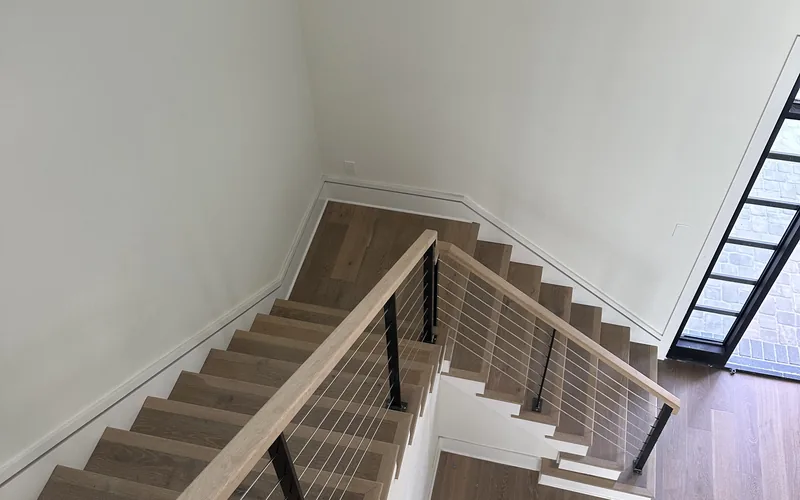
The premium choice. Made from solid wood (typically white oak, red oak, maple, hickory, or Brazilian cherry), 1-inch thick treads are heavy, substantial-feeling, and can be sanded and refinished multiple times. They typically have a built-in or laminated bullnose for the front edge.
Best for: Forever homes, premium new construction in Lakewood Ranch and Sarasota luxury communities, restoration projects where matching original hardwood character matters. We work most often with white oak and red oak for these projects.
LVP-Clad Treads
A pre-fabricated wood tread (typically pine or poplar) clad with LVP planks cut to fit. The bullnose is either a custom-mitered LVP nosing or a complementary stair-nosing molding. Most affordable option, and the only choice that visually matches an LVP floor.
Best for: Continuing an LVP main floor onto stairs, budget-conscious renovations, rental properties, homes that already have LVP throughout. We've cut LVP-clad treads for 200+ Tampa Bay projects.
Porcelain Tile Treads
Custom-cut porcelain tile with a non-slip nosing strip (Schluter-TREP or aluminum/brass). Best for outdoor stairs, modern-aesthetic interior stairs, and any application where extreme durability and water resistance matter.
Best for: Modern homes (especially in Sarasota and downtown St. Pete), exterior stairs, pool-side stairs, commercial properties.
2026 Cost Per Tread in Tampa Bay
| Component | Cost Per Unit | Notes |
|---|---|---|
| Hardwood tread (red/white oak) | $95-$165 each | Stained or natural finish |
| Hardwood tread (premium species) | $125-$220 each | Brazilian cherry, walnut, hickory |
| LVP-clad tread (custom bullnose) | $45-$85 each | Matches LVP main floor |
| Porcelain tile tread | $80-$150 each | With non-slip nosing strip |
| Matching painted risers | $25-$45 each | Primed and painted white |
| Matching wood risers | $45-$85 each | Same species as treads |
| Skirt board / stringer trim | $35-$70 / linear ft | Wall-side staircase trim |
| Carpet demolition (per stair) | $15-$30 each | Removes carpet and tack strips |
| Custom mitered returns (open side) | $45-$95 each | For visible side of treads |
Total project examples (typical 14-step staircase):
- LVP-clad treads + painted risers: $1,150-$1,800
- Standard hardwood treads + painted risers: $1,800-$3,500
- Premium hardwood treads + matching wood risers: $3,000-$5,500
- Carpet removal + new hardwood: Add $200-$420 for demolition
The Replacement Process
Step 1: Measurement and Material Selection (Day 0)
We come out for a precise measurement of every tread, riser, and stringer. Each step is measured individually because old staircases often have minor variations. We confirm material choice, finish, and any custom features (like wrapped returns on open-side treads).
Step 2: Demolition (Day 1, AM)
If replacing carpet, we remove the carpet, padding, and tack strips. If replacing existing wood treads, we pry up the old treads (often without damaging the existing risers). We inspect the substrate (typically pine or plywood treads) for level, squeaks, and damage.
Step 3: Substrate Repair (Day 1, PM)
Any squeaks are addressed by screwing the existing pine treads to the stringers. Loose or damaged substrate gets replaced. The substrate is leveled and sanded to provide a perfect surface for the new treads.
Step 4: New Riser Installation (Day 2, AM)
If installing new risers (wood or painted), these go in first. They're cut to height, scribed to fit any wall-side variations, and nailed/glued in place.
Step 5: Tread Installation (Day 2, PM through Day 3)
Each tread is custom-cut, scribed to fit, and mitered at any open-side returns. Treads are bonded to the substrate with construction adhesive and mechanically fastened. The nosing wraps over the riser below, creating a seamless visual transition.
Step 6: Skirt Board / Stringer Trim (Day 3 or Day 4)
Wall-side stringer trim ("skirt board") goes on after the treads. This trim covers the rough stringer and creates a finished look at the wall.
Step 7: Quarter-Round and Caulk (Day 4)
Small details — quarter-round at the wall edges of treads, caulk lines at the riser-tread joints, touch-up paint on adjacent baseboards. These small things make the difference between "okay" and "professional" installations.
Step 8: Final Walk-Through (Day 4 PM)
We walk every step with you, looking for any tiny issues. We check that every tread is solidly installed, every nosing is perfectly aligned, every miter joint is tight. Anything you flag, we address before we leave.
Design Decisions That Matter
Painted vs Wood Risers
Painted white risers (with stained wood treads) is the most popular look in Tampa Bay — it's clean, contemporary, and showcases the wood. Wood risers (matching the treads) is more traditional and creates a continuous wood appearance. Both are valid; the choice is aesthetic.
Stain Color
If you have existing hardwood floors in your home, matching the stair stain to your floors is usually the right call (continuous flooring transitions look more intentional). If you're starting fresh, popular 2026 stains in Tampa Bay are: medium-light "natural" tones, light gray-washed white oak, and warm honey-medium browns.
Open Side vs Closed Side
"Closed" stairs have walls on both sides — simpler installation. "Open" stairs (one or both sides exposed to a railing) require custom mitered returns on every visible tread end, which adds significantly to labor cost.
Bullnose Style
The front edge of each tread can be: rounded (most common, traditional), square (modern), beveled (contemporary), or custom-routed (premium). Different bullnose styles change the entire visual feel of the staircase.
Free in-home consultation across Tampa Bay. We'll measure your stairs, recommend the right material, and provide a written itemized quote within 24 hours.
Get My Free Quote →Common Mistakes to Avoid
- Hiring a "regular" flooring installer for stairs. Stair work is custom carpentry, not floor laying. Make sure the contractor specifically does stair treads regularly. Ask to see photos of recent stair work.
- Skipping the substrate prep. Squeaky stairs that don't get fixed before new treads go on will still squeak afterward — and the new treads will eventually loosen at the squeak point. Always address substrate issues first.
- Mismatched stain/color between treads and main floor. Stair treads should match your main hardwood floor as closely as possible. Even small mismatches are visible at every transition.
- Forgetting about light. Stairs in dim hallways (typical of older Florida homes) look dramatically different in installer-shop lighting vs. your home. Always look at samples in your actual home, in your actual light.
- Skimping on bullnose quality. The nosing is the most-touched, most-seen part of every tread. Cheap bullnose looks cheap forever — it's worth paying for solid hardwood or quality LVP nosing.
- Glossy finish on stairs. Glossy finishes are slippery (especially in socks). Matte or satin is safer for stairs.
Frequently Asked Questions
Can I replace carpet on stairs with hardwood?
Yes — this is one of our most common stair projects. We remove the carpet, padding, and tack strips; check the existing pine treads for level and squeaks; install solid hardwood treads on top with matching wood or painted risers. The whole conversion typically takes 2-3 days for a standard 14-step staircase.
How long do stair treads last?
Solid hardwood treads last 30-50+ years with refinishing every 8-15 years. LVP-clad treads last 15-25 years. Porcelain tile treads last 30-50+ years.
Can stair treads be matched to my existing hardwood floor?
Yes, in most cases. If your existing floor is from a major manufacturer (Anderson, Mirage, Mohawk, etc.), we can usually order matching solid stair treads from the same manufacturer. If your floor is LVP, we use the LVP planks themselves to clad pre-fabricated wood treads with custom-cut bullnose.
Do I need slip-resistant treads in Florida?
For interior residential stairs, slip resistance is mostly about finish choice (matte/satin = better grip than gloss). For exterior stairs, pool-side stairs, and commercial properties, we install proper non-slip nosing strips — either Schluter-TREP for tile, or aluminum/brass strips for hardwood.
How much does it cost to replace stair treads in Tampa Bay?
For a typical 14-step staircase: LVP-clad treads + painted risers $1,150-$1,800; standard hardwood treads + painted risers $1,800-$3,500; premium hardwood treads + matching wood risers $3,000-$5,500. Add $200-$420 for carpet removal if applicable.
Have a stair tread project in mind? Browse our stair tread services or request a free in-home consultation. We'll measure your specific staircase, recommend the right material for your home, and provide an itemized written quote.