For most Florida slab homes, rigid-core luxury vinyl plank is the best all-around floor — it's waterproof, handles slab moisture better than laminate, and costs far less than tile. Choose porcelain tile if you want maximum durability and resale value, and laminate only on a proven-dry slab on a tight budget.
Why do concrete slab homes change the flooring rules?
Almost every Florida home built since the 1960s sits on a concrete slab poured straight on grade — no crawlspace, no basement, no airflow underneath. That slab is in constant contact with damp soil, and in our 70–85% summer humidity it stays cooler than the room above it. The result is moisture vapor that pushes up through the concrete year-round, even when the slab looks bone dry.
That single fact rules out a lot of flooring that works fine up north. Anything that traps moisture, glues poorly to a damp slab, or swells when it gets wet is a liability here. You want a floor that either doesn't care about moisture at all (tile, vinyl) or one installed with a serious moisture barrier.
- No crawlspace means no way to ventilate the underside of the floor.
- Slabs telegraph cold and damp, so condensation can form under impermeable floors.
- Florida's flood and hurricane exposure rewards floors you can dry out and salvage.
It's also why I push back when a customer brings me a flooring idea they saw in a magazine from a Midwest renovation. Solid hardwood nailed to a subfloor, for example, simply has nowhere to be nailed on a slab, and gluing solid wood straight to concrete in our humidity is asking for cupping within a season or two. The floors that thrive here are the ones engineered for moisture from the start.
What are the best flooring types for a Florida slab?
Three options dominate slab homes in Tampa Bay, and there's a clear order for most people:
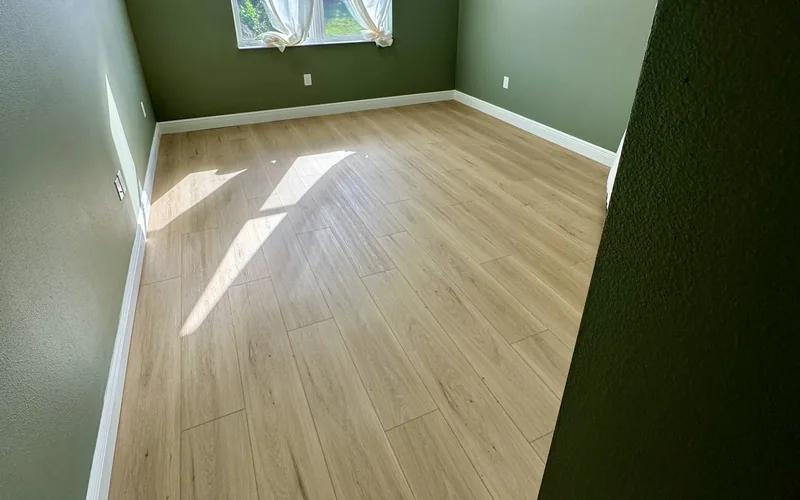
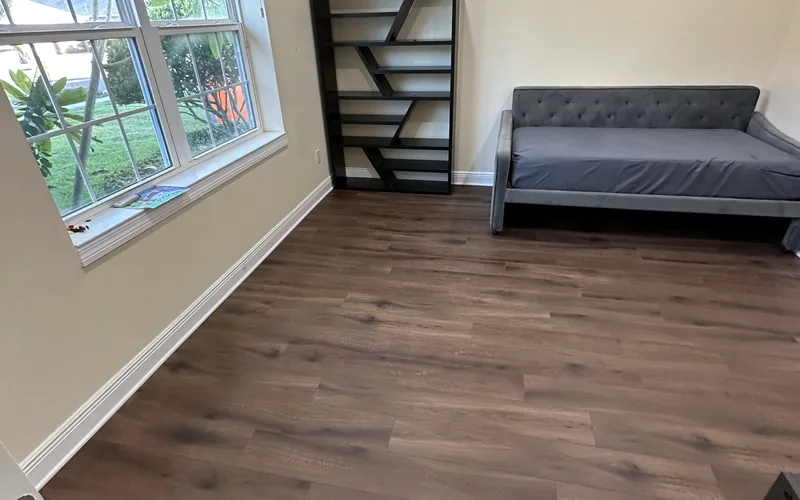
1. Rigid-core luxury vinyl plank (LVP/SPC) is the default winner. It's 100% waterproof, the rigid stone-polymer core barely moves with temperature and humidity swings, and it floats over the slab so minor unevenness gets handled by underlayment. It also feels warmer and quieter underfoot than tile. See our vinyl plank flooring page for the systems we install.
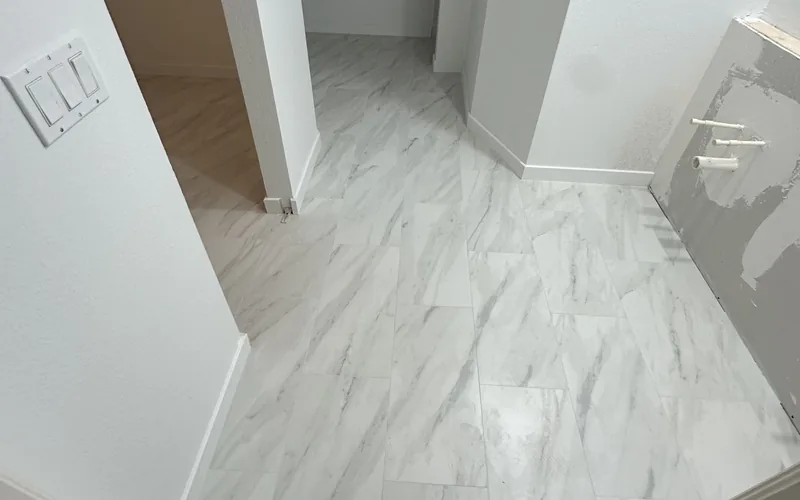
2. Porcelain tile is the most bulletproof choice — it's the one floor that genuinely does not care about a wet slab, flood, or dog. It's the standard recommendation for South Florida living areas and the best for resale. The trade-offs are hard underfoot, cold-feeling, and the highest install cost. Our tile installation page covers the details.
3. Laminate can work, but only on a slab proven dry with a quality vapor barrier. Its fiberboard core swells permanently if water gets to it, so we treat it as the budget option for bedrooms and low-risk rooms, not kitchens or entries. Compare it on our laminate flooring page.
How does slab moisture wreck the wrong floor?
This is the failure I get called out to fix most often. Moisture vapor migrating up through a slab doesn't show as a puddle — it shows up months later as cupped boards, peeling adhesive, dark blotches, or a musty smell. Trapped under an impermeable floor with no vapor barrier, that moisture feeds mold and breaks down glue.
The fix isn't a product, it's a moisture test plus the right barrier. Before any glue-down or laminate job, the slab should be tested (calcium chloride or relative-humidity probe). High readings mean you either use a floating waterproof floor or apply a liquid moisture-mitigation coating first.
Vapor barriers control rising vapor, but they can't stop liquid water from a plumbing leak, hydrostatic pressure, or a flood. If water is actually coming up through the slab, that's a drainage or foundation issue to solve first — and if you already have damage, see water damage repair.
I've torn out plenty of two-year-old glue-down jobs where someone skipped the moisture test to save a couple hundred dollars, then paid for the whole floor twice. The test is cheap insurance. On a typical living room it's a small line item, and it's the single best predictor of whether a floor will still look good in five years.
Vinyl plank vs tile vs laminate — which wins on a slab?
Here's the honest head-to-head for slab-on-grade homes in our climate:
| Factor | Rigid-core vinyl plank | Porcelain tile | Laminate |
|---|---|---|---|
| Waterproof | Yes (100%) | Yes | No — swells if wet |
| Handles slab vapor | Excellent (floats) | Excellent | Only with barrier |
| Comfort underfoot | Warm, soft | Hard, cold | Warm, soft |
| Flood recovery | Often salvageable | Best | Usually a tear-out |
| DIY-friendly | Yes (click-lock) | No | Yes |
| Resale appeal | Good | Best | Lower |
| Lifespan | 15–25 yrs | 30–50+ yrs | 10–20 yrs |
Bottom line: vinyl plank is the best balance of waterproofing, comfort, and price; tile is the long-haul champion if you can live with hard and cold; laminate is the budget pick where moisture risk is genuinely low. For a deeper material breakdown, our waterproof flooring guide goes further.
What slab prep do you need before installing?
Most flooring failures on slabs trace back to skipped prep, not a bad product. A proper slab install includes:
- Moisture testing — relative-humidity probes or calcium chloride before glue-down or laminate.
- Flatness check — the slab should be flat within about 3/16" over 10 feet; high spots ground down, low spots filled with self-leveler.
- Crack repair — active cracks get filled and, where needed, an isolation/crack-suppression membrane under tile.
- Vapor barrier — a 6-mil sheet (floating floors) or a liquid mitigation coating (glue-down) where readings are high.
- Clean, dry surface — old adhesive, paint, and dust removed so the new floor or thinset bonds.
Floating rigid-core vinyl is the most forgiving over a slightly imperfect slab, which is one reason it's so popular here. Tile is the least forgiving — a slab that isn't flat shows up as lippage between tiles.
One Florida-specific note on prep: don't let an installer rush the acclimation step. Even waterproof vinyl plank should sit in the room for a day or two so it adjusts to the home's temperature and humidity before it's locked together. In a house that swings from a chilly A/C summer to a closed-up empty rental, skipping that step is how you get gaps at the seams later. Good prep is unglamorous, but it's 80% of whether a slab floor succeeds.
What does slab flooring cost in 2026?
These are typical installed ranges for the Tampa Bay / Sarasota–Manatee market in 2026, including standard slab prep. Heavy moisture mitigation, leveling, or premium materials push you toward the top of each range.
| Flooring type | Material only | Installed (incl. prep) |
|---|---|---|
| Laminate | $1 - $4 / sq ft | $4 - $10 / sq ft |
| Rigid-core vinyl plank (LVP/SPC) | $3 - $8 / sq ft | $5 - $12 / sq ft |
| Porcelain tile | $3 - $12 / sq ft | $12 - $25 / sq ft |
Watch the add-ons that calculators miss: old-floor removal runs about $1–$2.50/sq ft (more for glued vinyl or old tile), and liquid moisture mitigation on a wet slab can add $1.50–$4/sq ft. For city-by-city numbers, see our 2026 vinyl plank cost breakdown.
How do I pick the right floor for my room?
Match the floor to the risk and the use, not just the look:
- Kitchens, entries, laundry, anywhere near water: tile or rigid-core vinyl. Never laminate.
- Living areas and bedrooms on a dry slab: vinyl plank for comfort, laminate if budget is tight.
- Flood-prone or ground-floor coastal rooms: porcelain tile — it survives standing water and dries out.
- Pet households: rigid-core vinyl or tile resist scratches and accidents best.
When in doubt in our climate, default to waterproof. A floor that shrugs off a leak or a hurricane saves you a full tear-out later. If you're weighing it against your specific slab and budget, we write honest repair-or-replace plans across the area — start at our vinyl plank flooring hub.
Frequently Asked Questions
Can you install vinyl plank directly on a concrete slab?
Yes. Rigid-core (SPC) vinyl plank floats directly over a clean, flat slab with an underlayment, no glue required. It's waterproof and tolerant of slab moisture, which makes it one of the best slab floors for Florida. Just confirm the slab is flat within about 3/16" over 10 feet first.
Do I need a vapor barrier over a concrete slab in Florida?
Almost always, yes. Florida slabs sit on damp soil and push moisture vapor upward year-round. Floating floors use a 6-mil poly sheet; glue-down floors may need a liquid moisture-mitigation coating. A moisture test tells you how much protection you actually need.
Is laminate a bad idea on a slab?
Not bad, but riskier. Laminate's fiberboard core swells permanently if water reaches it, so it's only safe on a slab proven dry and with a quality vapor barrier. We keep it to bedrooms and low-risk rooms, never kitchens, baths, or entries.
Why does tile cost so much more than vinyl plank?
Tile is labor-intensive — slab prep, crack-isolation membrane, thinset, setting, and grouting all take skilled time. In 2026 installed porcelain tile runs roughly $12–$25/sq ft versus $5–$12 for rigid-core vinyl. You're paying for a floor that lasts 30–50+ years and boosts resale.
What flooring is best if my area floods?
Porcelain tile is the clear winner — it survives standing water and dries out with no damage. Rigid-core vinyl is often salvageable after a flood, while laminate almost always becomes a tear-out. For flood-prone ground floors, tile is worth the extra cost.
How do I know if my slab is too wet to install over?
Get a moisture test — a relative-humidity probe or calcium chloride test reads the slab before installation. High readings mean you use a floating waterproof floor or apply moisture mitigation first. Visible dark spots, a musty smell, or condensation are red flags to test before you buy any flooring.
Does flooring over a slab feel cold in winter?
Tile feels cool because it conducts the slab's temperature, which many Florida homeowners actually like in summer. Vinyl plank and laminate have a softer, warmer feel underfoot. If comfort matters, vinyl plank is the better slab choice; area rugs help with tile.