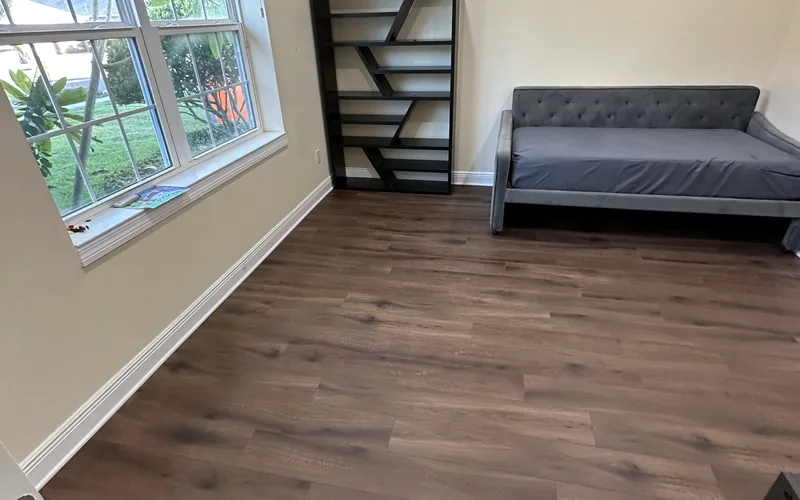
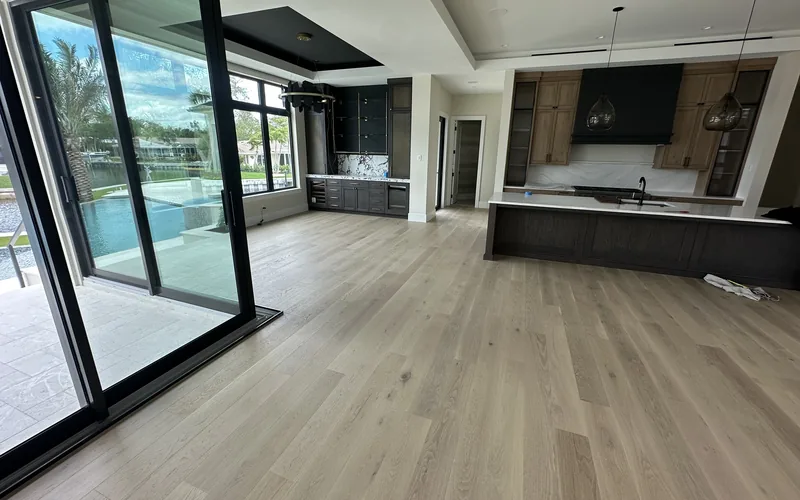
Hardwood cups and buckles in Florida because the underside of the boards picks up more moisture than the top. Almost always it's humidity above 55%, a slab without a vapor barrier, or a slow leak. Fix the moisture source first — sanding a wet floor flat just guarantees it cups again.
What's the difference between cupping and buckling?
They're two stages of the same moisture problem, and knowing which one you have tells you how serious it is.
- Cupping is when the edges of each board rise higher than the center, so the surface looks like a row of shallow troughs. It's the early warning sign — the underside of the wood is wetter than the top, so it swells and curls upward.
- Buckling is the severe stage: boards lift completely off the subfloor, sometimes by an inch or more, or tent up at the seams. This usually means a real water event — a flood, a burst supply line, or weeks of saturation under the wood.
- Crowning is the opposite of cupping (center higher than edges) and almost always happens when someone sands a still-wet cupped floor flat, then the wood finally dries.
Cupping is often reversible. Buckling almost never fully reverses, because the wood fibers and the fasteners have usually been damaged.
A quick field test: lay a straightedge across several boards. If the edges touch and the centers dip, that's cupping. If whole boards or seams lift off the subfloor, that's buckling. The deeper the dip and the wider the area, the more moisture is involved — and the more likely you'll need to pull boards rather than just sand.
Why does this happen so much in Florida?
Florida is the second-most-humid state in the country, with average relative humidity sitting around 74%. Wood is hygroscopic — it constantly absorbs and releases moisture to match the air around it — so our climate works against every wood floor in the state. Three Florida-specific things make it worse:
- Concrete slab construction. Most homes from Bradenton to Palmetto are built on slab. If the slab was poured without an intact vapor barrier underneath, or the wood was glued down before the slab fully cured, ground moisture wicks up into the underside of the planks for years.
- The AC habit. Snowbird homes and vacation rentals get the AC shut off or set to 80°F+ for weeks. Indoor humidity climbs past 60–70% and the floor cups every summer.
- Storm and flood exposure. A few hours of standing water from a hurricane or a roof leak is enough to saturate the subfloor and trigger buckling.
The fix almost always starts with controlling moisture, not the wood. We cover the worst-case version in our guide to water-damaged hardwood floor repair in Florida.
Will cupped hardwood flatten back out on its own?
Often, yes — if the cupping is mild and you fix the moisture source. Humidity-driven cupping is the least severe type. Once you get the air back under 50% RH and the underside of the wood dries down to match the top, slightly cupped boards frequently flatten over several weeks to a few months, especially heading into the drier winter season.
What it needs to recover:
- The leak or moisture source is found and stopped.
- Indoor RH held between 30% and 50% with the AC and/or a dehumidifier running.
- Time — weeks, not days. Drying too fast with heaters or fans aimed at the floor causes splits and crowning.
Track it with a moisture meter rather than your eyes. Take a reading on the boards and the slab when you start, then again every week. When the wood's moisture content stops dropping and matches the home's normal level, the floor has done all the recovering it's going to do — that's when you decide whether it flattened enough or needs sanding.
If boards are buckled, lifted, or have black staining and a musty smell, they won't recover on their own and you're into floor repair territory.
How do you actually fix a cupped or buckled floor?
The order matters. Skipping step one is the single most common mistake — and the most expensive.
- Find and stop the moisture. Plumbing leak, dishwasher or fridge line, slab vapor intrusion, or just runaway humidity. Get a moisture meter on the boards and the slab.
- Dry it down slowly and evenly. Run the AC, add a dehumidifier, and let the wood's moisture content come back into equilibrium with the room. This can take 2–6 weeks.
- Measure before you sand. The wood's moisture content should match the home's equilibrium moisture content (EMC) before anyone touches it with a sander.
- Sand flat, then refinish — only once it's dry and flat. See hardwood refinishing for what that involves.
- Replace boards that buckled or have fractured fibers. Standing water and mold damage mean board-out, not sand-down — that's where water-damage floor repair comes in.
If you sand a cupped floor while it's still wet, it will look perfect for a month and then crown as it dries — and now you've burned a sanding life off the floor for nothing.
What does sanding and refinishing a cupped floor cost in 2026?
If the floor dries flat and the boards are sound, refinishing is the whole repair. In the Tampa Bay market in 2026, professional sand-and-refinish work generally runs in line with national pricing of about $3 to $8 per square foot, with low-dust ("dustless") setups landing toward the $5–$8 range. A typical room or small project lands in the low-to-mid four figures.
| Service | What's involved | Typical 2026 cost |
|---|---|---|
| Standard sand & refinish | Sand, stain, finish | $3 – $6 / sq ft |
| Dustless refinish | Same, with vacuum-sanding | $5 – $8 / sq ft |
| Spot board replacement + blend | Swap damaged boards, re-sand area | $8 – $15 / sq ft |
| Moisture testing / inspection | Meter readings, slab test | $150 – $400 |
Ranges depend on species, square footage, and how much board replacement the cupping left behind. Always get the moisture reading documented before you pay for sanding.
Should you repair the floor or replace it?
Here's the honest contractor answer: it comes down to how wet the wood got, for how long, and whether it's solid or engineered.
| Situation | Best move | Why |
|---|---|---|
| Mild seasonal cupping, no leak | Control humidity, wait, maybe refinish | Cheapest — often flattens out |
| Solid wood, dried flat, sound boards | Sand & refinish | $3 – $8 / sq ft |
| Engineered wood, cupped | Usually replace affected area | Thin wear layer can't re-sand much |
| Buckled, mold, or slab moisture | Replace + fix the source | Sanding won't hold |
Engineered floors have a thin top veneer, so once they cup badly there often isn't enough wood to sand flat — replacement of the affected area is usually the call. Solid ¾" hardwood gives you more sanding life and more chances to save it. If you're weighing materials for a fresh install, our hardwood flooring page covers what holds up on Florida slab.
How do you keep it from happening again?
Prevention is cheap compared to a re-sand. The whole game is keeping the moisture under and around the wood stable.
- Hold indoor relative humidity between 30% and 50% year-round. A $20 hygrometer tells you where you stand.
- Never shut the AC fully off in a vacant Florida home. Set it to 78–80°F or run a dehumidifier so RH stays in range.
- Acclimate new wood in the home for several days before install, and use a vapor barrier or moisture-mitigation coat on slabs.
- Clean damp, not wet. Skip steam mops and sopping mops on hardwood — use a barely-damp microfiber.
- Catch leaks early. Dishwasher, fridge line, and AC condensate lines are the usual Florida culprits.
It's also worth checking your slab and crawlspace once a year for damp spots, and making sure exterior grading carries rainwater away from the foundation. Most of the buckling jobs we see across Bradenton, Sarasota, and Palmetto trace back to a problem that was visible months before the floor moved.
Do those five things and most Florida hardwood will never cup past the cosmetic stage.
Getting a cupped floor looked at in Bradenton, Lakewood Ranch or Sarasota
Find and stop the moisture source first. After that, boards that settle back are a floor repair in Bradenton or in Lakewood Ranch; boards that stay cupped get replaced. Once the boards are dry and flat again, hardwood refinishing in Sarasota explains the sand-and-finish step. Repair diagnosis visits are $95, waived if you book the work.
Frequently Asked Questions
Is cupping covered by homeowners insurance in Florida?
If the cupping comes from a sudden covered event — a burst pipe or appliance overflow — it's often covered. Cupping from long-term humidity, a slow undetected leak, or flood water usually isn't. Document the source and date with photos and moisture readings.
How long does a cupped floor take to flatten out?
With the moisture source fixed and indoor humidity held at 30–50%, mild cupping often flattens over several weeks to a few months. Don't rush it with heaters or fans aimed at the wood — fast, uneven drying causes splits and crowning.
Can you sand a cupped floor flat right away?
No. Sand only after the wood has dried and the boards have flattened on their own. Sanding a wet, cupped floor makes it look fine briefly, then it crowns (center rises) as it dries — and you've wasted a sanding off the floor's life.
Does engineered hardwood cup too?
Yes. Engineered wood resists humidity better than solid, but it still cups when the underside gets wetter than the top. Because its wear layer is thin, badly cupped engineered boards usually have to be replaced rather than sanded flat.
What humidity level prevents hardwood cupping?
Keep indoor relative humidity between 30% and 50%, and ideally under 55%, year-round. In Florida that means running the AC or a dehumidifier even in vacant homes, since outdoor humidity averages around 74%.
My floor buckled after a hurricane — can it be saved?
Rarely as-is. Standing water saturates the subfloor and warps the fasteners, so buckled boards almost always need replacement plus drying and mold checks under the floor. See our water-damage floor repair page and act fast to limit mold.
Why is only one room or one wall cupping?
Localized cupping points to a localized moisture source — a nearby plumbing or appliance leak, an exterior wall with poor drainage, or a section of slab without a vapor barrier. Find that source before any repair.