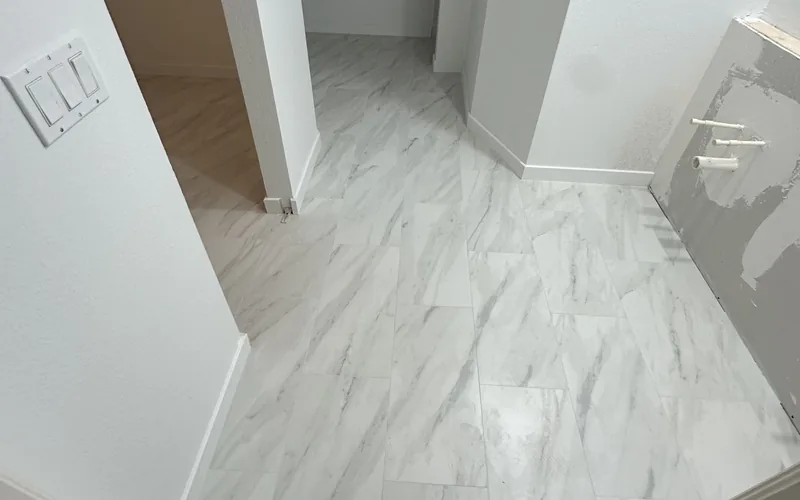
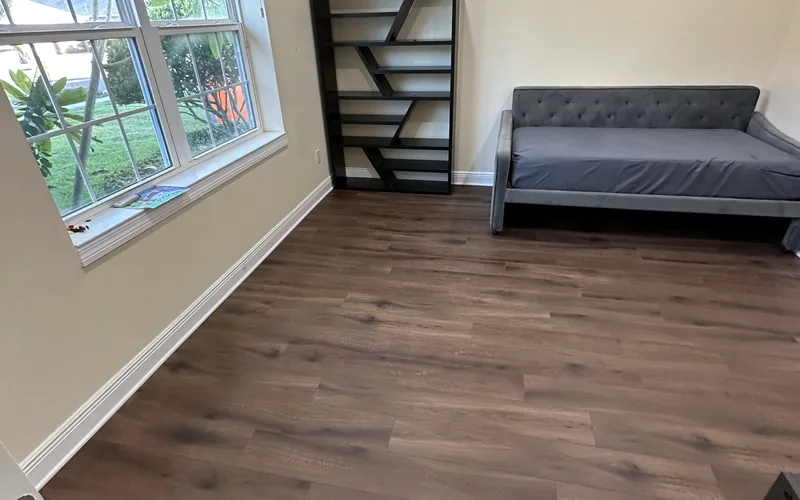
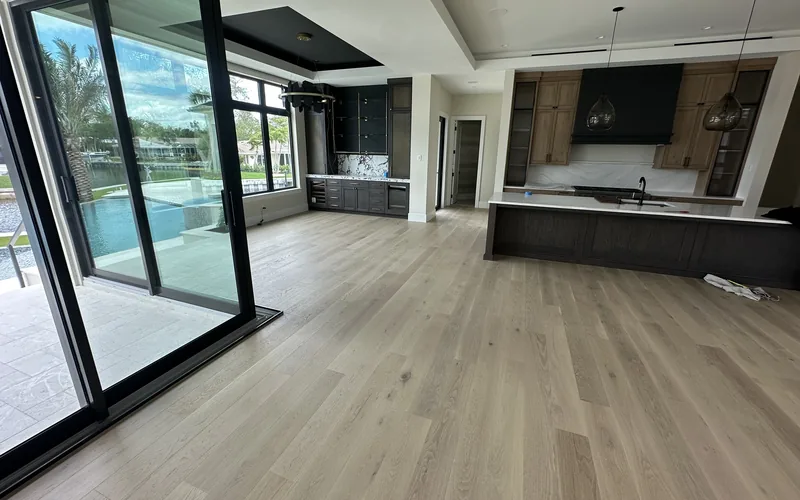
Yes: new flooring counts toward the FEMA 50% rule. In Manatee County, if repairing a flood-zone home that sits below flood protection elevation costs 50% or more of the building's value, land excluded, the whole house must meet current flood rules, usually by elevating it. Tile, stone or carpet over subfloor, demolition labor and contractor profit all count.
What is the FEMA 50% rule in Manatee County?
Manatee County enforces this National Flood Insurance Program rule, and its FEMA 50% Rule application packet sets three triggers:
- Substantial damage: damage of any origin where restoring the building to its before-damaged condition "would equal or exceed fifty (50) per cent of the market value" of the building before the damage.
- Repeat flooding: flood damage "on two (2) separate occasions during a ten-year period" where the repair cost at each event, on average, equals or exceeds 25 per cent of market value.
- Substantial improvement: repairs, remodeling or additions "taking place during a one-year period, the cumulative cost of which equals or exceeds fifty (50) per cent of the market value."
The rule only applies if the house is in a special flood hazard area (Zones A, AE or VE) and its finished floor or its electrical, plumbing or mechanical equipment sits below the current Flood Protection Elevation: base flood elevation plus 1 foot, or the design flood elevation if that is higher. If an elevation certificate shows the home is at or above that line, the county's post-storm floodplain guidance says the rule does not apply.
When the work crosses the line, the whole building has to be brought into compliance, usually by elevating it, with equipment, bathrooms and laundry rooms raised too. Below the flood level, only parking, building access and limited storage are allowed.
Does new flooring count toward the 50% rule?
Yes. The Manatee packet lists what reviewers add up, and floor coverings are on the included side. Its cost form has separate lines for "Kitchen & Bath Tile or flooring" and "Flooring Complete," each split into material and labor. How it sorts a typical floor job:
| Cost on your estimate | Counts toward 50%? | Packet wording |
|---|---|---|
| Floor covering installed over the subfloor | Included | "Tiling, linoleum, stone, or carpet over sub-flooring" |
| Tearing out the damaged floor | Included | "Labor and other costs associated with demolishing, removing or altering building components" |
| Contractor overhead and profit | Included | "Overhead and profit" |
| Rugs or carpet laid over a finished floor | Excluded | "throw rugs (carpeting over finished floors)" |
| Hauling debris, dumpster, landfill fees | Excluded | "Debris removal" |
| Mud-out and drying the house | Excluded | "Clean-up (e.g., dirt and mud removal, building dry out, etc.)" |
| Permit fees | Excluded | "Permit fees" |
The included list says "including but not limited to," so unnamed floors such as vinyl plank still count. Two more lines matter: "For damage repairs, pre-storm prices and rates will be utilized," and the contractor signs an affidavit that the estimate covers "all damages or all improvements to your home, not just structural." Doing the floor yourself does not hide it either: the packet values owner labor at $30 an hour. The floor belongs on the estimate, line by line.
How is market value figured in Manatee and Sarasota?
Market value means the building, not the lot. Manatee uses "the tax assessment value of your structure (excluding the land and features)". If you disagree, you can submit a certified appraisal from a state-licensed appraiser, certified no more than 12 months before the application and covering the building only (Manatee 50% packet).
In Sarasota County, the Property Appraiser's FEMA 50% page gives this shortcut for "Properties in a designated flood zone that suffered substantial damage": "Take the most recent improvement value and multiply it by a factor of 1.2. The threshold will be 50% of the resulting number." It also says a private appraisal is the best option. The City of Sarasota's 2024 package uses the structure's assessed value, excluding land, or a licensed appraisal, and says repair costs "must include all costs necessary to fully repair the structure."
| Example: $200,000 building value | Manatee County packet | Sarasota Property Appraiser shortcut |
|---|---|---|
| Value used | Structure's tax assessment value, land excluded | Most recent pre-damage improvement value |
| Adjustment | None | × 1.2 = $240,000 |
| 50% threshold | $100,000 | $120,000 |
| Two floods in 10 years | Average repair of $50,000 or more per flood (25%) | Ask your permitting office |
| If you think the value is low | Certified appraisal, building only, 12 months or newer | Appraisal by a state-licensed appraiser |
The dollar figures are only an illustration. The permitting office makes the determination, and inside a city with its own building department, that city decides.
How much of the 50% budget does a new floor use?
More than most owners expect. Using the installed ranges in our 2026 flooring cost report, 1,500 sq ft of porcelain or ceramic tile at $7.50–$22.00 per sq ft comes to about $11,250–$33,000, and the same area in vinyl plank at $3.91–$11.11 comes to about $5,865–$16,665. Against a $100,000 threshold, that is roughly 11–33% or 6–17% of the allowance from flooring alone, before drywall, baseboards, doors, cabinets and electrical, which the same water usually reaches.
Two caveats. Manatee prices damage repairs at pre-storm rates, so the county's number can differ from a 2026 quote. And because substantial improvement is counted over a one-year period (Manatee packet), a floor installed a few months after the drywall still lands in the same total. Splitting the job does not reset the count.
Ask any flooring contractor, us included, for a written quote that separates material and labor. That is how the county's form is laid out.
Do you need a permit for floor and drywall repairs in a flood zone?
In Manatee County, location decides it. The county's post-storm floodplain guidance (February 2025) says for drywall: "Substantial Damage Review is required if the structure is located within a flood zone." It adds: "A permit will not be required for drywall repair if the structure is located outside a flood zone. However, a permit may be required based on scope of work." The 50% packet goes further: "All repairs and improvements must be permitted through Manatee County Development Services for properties subject to the Substantial Improvement/Damage review." The floor is one of those repairs.
Florida's new $7,500 permit exemption does not change this. HB 803 (2026), in effect since July 1, 2026, exempts single-family owners from permits for work valued under $7,500, but the enrolled text says the exemption does not apply to "Work on a property that is partially or entirely located in a flood hazard area as defined by the Florida Building Code."
If any part of your lot is in a flood hazard area, call the building department before the old floor comes out. The damage review needs the full repair cost, floors included.
Which floors does FEMA accept below base flood elevation?
FEMA's list is in NFIP Technical Bulletin 2 (January 2025), which replaced the 2008 edition and its five-class scale with a plain acceptable or unacceptable rating. To pass, a material must withstand "direct and prolonged contact with floodwater", defined as at least 72 hours, with no more than cosmetic repair such as cleaning, sanitizing or repairing joints.
| Floor finish (TB-2, Table 2) | Rating below BFE |
|---|---|
| Ceramic or porcelain tile, mortar set | Acceptable |
| Ceramic or porcelain tile, organic adhesives | Unacceptable |
| Concrete tile, mortar set | Acceptable |
| Terrazzo | Acceptable |
| Epoxy flooring, formed in place | Acceptable |
| Homogeneous vinyl sheets or tiles, chemical-set adhesives | Acceptable |
| Homogeneous vinyl sheets or tiles, other applications | Unacceptable |
| Vinyl on cork or wood-product backing | Unacceptable |
| Carpeting | Unacceptable |
| Linoleum | Unacceptable |
| Solid wood, engineered wood, plastic laminate | Unacceptable |
Floating rigid-core vinyl plank is not on the list. TB-2 says unlisted materials may be used if accepted by the local official as flood damage resistant, based on evidence such as testing under ASTM E3075 and E3369, published in March 2024. Ask the manufacturer for that data.
The table governs areas below BFE in new construction and in substantially damaged or improved buildings, whose living floor must be elevated anyway, so on a rebuilt house it mostly covers the garage, entry and storage below. For flood-prone homes outside the mapped zone, TB-2 recommends replacing "wooden floorboards and carpet with tile, vinyl, rubber, or other flood-resistant materials." Room-by-room picks are in our waterproof flooring guide.
Why does the same vinyl pass on concrete but fail on plywood?
Because FEMA rates the assembly, not just the product. TB-2 puts it in one sentence: "Vinyl tile with chemical-set adhesives is an acceptable finish flooring material when placed on a concrete structural floor, but when the same vinyl tile is applied over a plywood structural floor, it is not considered acceptable because the vinyl tile must be removed to allow the plywood to dry."
The tile rows follow the same logic: porcelain set in mortar passes, while the same tile stuck down with organic adhesive does not. Most homes here sit on a concrete slab, which helps. Elevated homes, wood-framed additions and some older houses have wood subfloors, where a sealed finish floor keeps the wood from drying.
Before a flood-zone rebuild, find out what is under the finish floor and what holds it down. That decides whether it passes, not the product name. If you are re-tiling a slab, ask for the setting material on the quote; our tile installation page covers the rest.
Can tile on a slab survive a flood?
Often, yes. In FEMA flood insurance appeal D4, a one-story slab-on-grade home took a 20-inch interior waterline in Hurricane Ian. The adjuster allowed cleaning, regrouting and sealing the tile, and FEMA upheld the denial of replacement, finding that "ceramic tiles properly installed in a thin-set mortar on top of a concrete slab with cementitious grout, creates a flood damage-resistant floor assembly." FEMA added: "If properly cleaned, regrouted, and sealed, these components would be salvageable following a flood event."
The same decision says water trapped under tile points to "de-bonding," a pre-existing condition that can come from missing expansion joints or from heat, sun and humidity. Replacement could be justified if sediment abraded the tile surface or a wood product is part of the tile assembly.
For the 50% rule, a bonded tile floor that only needs cleaning and regrouting is a much smaller line than a tear-out. The estimate still has to show what is actually damaged. A water damage floor repair visit starts by sorting what can be cleaned from what has to come out. What flood insurance pays is covered in our flooring insurance guide.
What should you do before replacing floors in a flood zone?
- Find your flood zone and building value. Sarasota County owners can look up both on the Property Appraiser's site; Manatee starts from the structure's assessed value.
- Get an elevation certificate. Manatee requires one, or an elevation survey, in Zones A, AE and VE to decide whether the rule applies.
- Photograph everything before tear-out. Manatee's post-storm guidance tells owners to "Take photographs of all building damage and damaged contents."
- Get itemized, signed quotes. Material and labor separated, priced room by room.
- Ask the floodplain office first. Manatee: [email protected]. City of Sarasota Building Division: (941) 263-6494.
Triangle Flooring is based in Palmetto and installs and repairs floors across Manatee and Sarasota counties, including Bradenton and Sarasota. Measurement is free and the itemized written quote arrives within 24 hours; call (941) 402-6861.
This is general information, not legal or insurance advice. Confirm your situation with your building department or floodplain office, and with your insurance agent or adjuster.
Last verified: October 15, 2026.
Frequently Asked Questions
What is the FEMA 50 percent rule in Sarasota County?
It is the National Flood Insurance Program rule that a building in a designated flood zone whose repairs or improvements cost 50 percent or more of its market value must be brought up to current flood regulations, which can mean elevating it. The Sarasota County Property Appraiser explains one way to estimate the limit: take the most recent improvement value, multiply it by 1.2, and the threshold is 50 percent of the result. A state-licensed appraisal can be used instead, and the permitting office makes the final call.
Does replacing flooring after a flood count toward the 50% rule in Manatee County?
Yes. Manatee County's 50% packet lists tiling, linoleum, stone or carpet over sub-flooring as included costs, along with demolition labor and contractor overhead and profit. Rugs or carpet laid over a finished floor, debris removal, dry-out and permit fees are excluded.
Does a second flood within 10 years change the rules for my house?
It can. Manatee County's definition of substantial damage also covers flood damage on two separate occasions in a ten-year period where the repair cost at each event averages 25 percent or more of the building's market value. If your home flooded in both Helene and Milton, ask the floodplain office how both repairs are being counted.
Does the value of my land count in the 50% calculation?
No. Manatee County uses the tax assessment value of the structure, excluding the land and features, unless you submit a certified appraisal of the building. The City of Sarasota also uses the structure's assessed value without the land, or a licensed appraisal.
Do I need a permit to replace flooring in a flood zone after a storm?
Plan on talking to the building department first. Manatee County requires a substantial damage review for flood-zone homes, and all repairs on properties under that review must be permitted. Florida's new $7,500 permit exemption under HB 803 does not apply to property partly or entirely in a flood hazard area.
Is luxury vinyl plank considered flood-resistant by FEMA?
Not by name. FEMA's Technical Bulletin 2 (2025) rates homogeneous vinyl sheets or tiles with chemical-set adhesives as acceptable and other vinyl applications as unacceptable, and it does not list floating rigid-core plank. Unlisted materials can be accepted by the local official based on evidence such as ASTM E3075 and E3369 testing.
Does tile have to be replaced after a flood?
Not always. In FEMA appeal D4 after Hurricane Ian, FEMA found that ceramic tile set in thin-set mortar on a slab with cementitious grout is a flood damage-resistant assembly that can be salvaged by cleaning, regrouting and sealing. Tile that was already debonded, was abraded by sediment, or has a wood product in its assembly is a different case.
Do drying out and debris removal count toward the 50%?
No. Manatee County's packet excludes clean-up such as dirt and mud removal and building dry-out, debris removal including dumpsters and landfill fees, and permit fees. The repair and replacement work itself, including demolition labor, is counted.