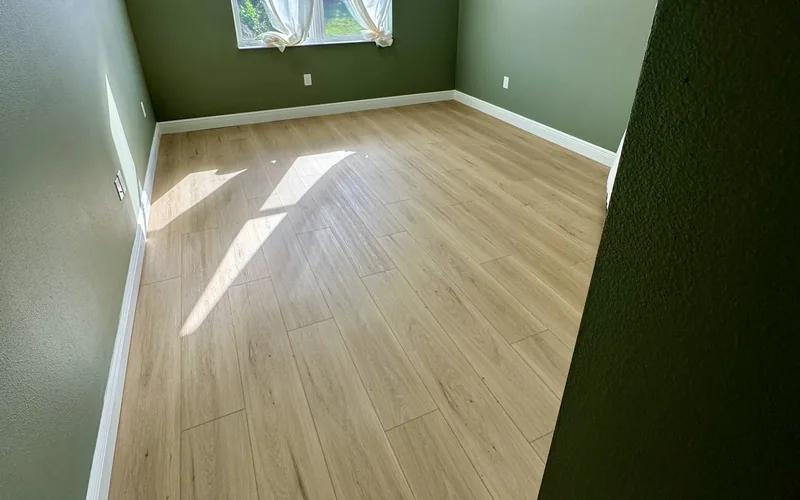
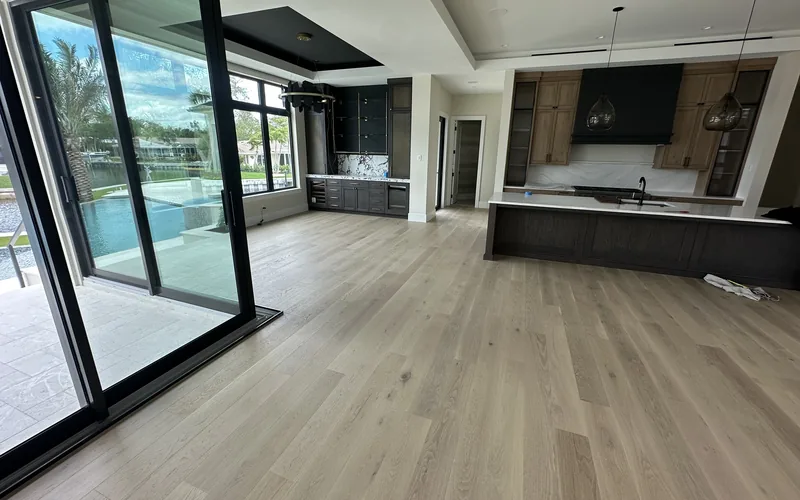
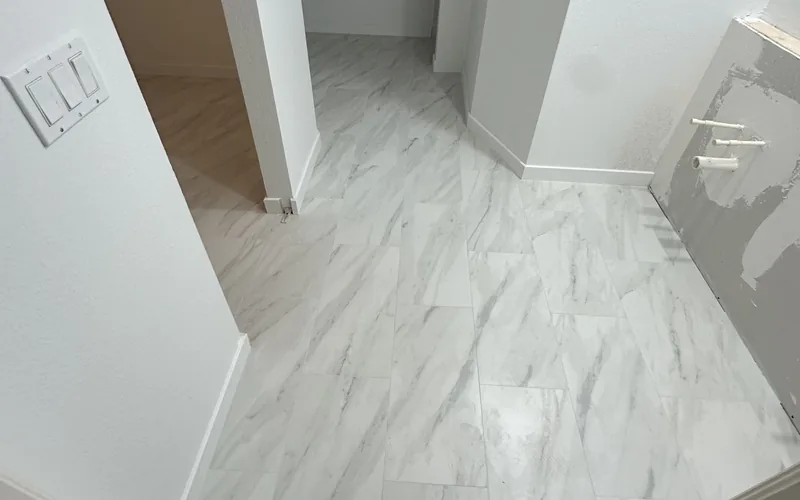
Yes — you can float luxury vinyl plank or laminate directly over existing ceramic or porcelain tile in most Florida homes, as long as the tile is solid, flat, and dry. The catch is prep: grout lines deeper than 1/8 inch must be filled and any high tiles (lippage) leveled, or they will telegraph through the new floor.
Can you really install LVP or laminate over existing tile?
In most cases, yes. Both luxury vinyl plank (LVP) and laminate use a click-lock floating system that is designed to sit on top of an existing hard surface — including ceramic and porcelain tile — without glue or nails. The planks lock to each other, not to the floor below, so the tile becomes the subfloor.
Here in Bradenton, Sarasota, and Palmetto, this is one of the most common requests I get. A lot of slab homes were tiled in the '90s and 2000s with dated 12x12 or 16x16 porcelain, and homeowners want a wood look without the dust, cost, and slab damage of jackhammering tile off concrete.
The honest answer is that going over tile saves real money and mess — but only when the existing tile passes three tests: it is well-bonded (no hollow or loose tiles), flat (no big height differences between tiles), and dry (no slab moisture problem underneath). If your tile fails those, prep cost climbs and tear-out may actually be the smarter call.
When does going over tile work — and when should you tear it out?
The deciding factor is the condition of the tile, not the tile itself. Sound, flat tile is a great base. Cracked, loose, or wavy tile is a liability.
Going over the tile makes sense when:
- Tiles are firmly bonded — tap around and listen for hollow spots; fix or re-bed any that move.
- Grout lines are narrow and close to flush (under 1/8 inch deep).
- The floor is flat with no major lippage (one tile edge sitting higher than its neighbor).
- You have door and appliance clearance for the added height.
Pull the tile up instead when:
- Multiple tiles are loose, drummy, or cracked — a failing base makes the new floor fail.
- The floor has significant slope or lippage that leveling can't economically fix.
- There's a known slab moisture issue, or the tile sits in a flood-prone area.
- Adding height would create a trip hazard or block a door or slider.
If you're already seeing loose or cracked tile, that's a repair conversation first. Our floor repair team can tell you whether the existing tile is a usable base or a tear-out before you spend a dime on new flooring.
How do you prep tile so grout lines don't telegraph through?
"Telegraphing" is when the grout-line grid below shows through — or worse, feels through — the new floor. It's the #1 thing that makes a tile-over job look cheap, and it's almost always a prep problem, not a product problem.
How you handle grout lines depends on their depth:
| Grout line condition | What to do |
|---|---|
| Flush / under 1/8" deep | No filling needed. Lay a quality underlayment and float directly. |
| 1/8" to 1/4" deep | Skim-coat the lines with floor patch or feather finish, then underlayment. |
| Deeper than 1/4" or uneven tile | Apply self-leveling compound over the whole floor, or pour-fill the lines. |
The full prep sequence is simple but skipping it is what causes squeaks, rocking, and separating seams later:
- Clean and degrease — strip off any wax, mop residue, or grease, especially in kitchens.
- Fix the base — re-bond hollow tiles, patch any chips with mortar.
- Level grout lines and lippage — fill deep joints; grind down or self-level high tiles.
- Add the right underlayment — a thin pad smooths minor texture and adds sound dampening (skip the attached-pad debate below).
- Leave expansion gaps — 1/4 inch at every wall so the floating floor can move with Florida's humidity swings.
LVP vs. laminate over tile: which holds up better in Florida?
Both can go over tile, but in our 70–85% humidity — and with the flood and hurricane exposure on the Gulf Coast — they are not equal. Rigid-core LVP (SPC) is waterproof to the core; laminate has a wood-fiber (HDF) core that swells permanently if water gets into the seams.
| Factor | Rigid-core LVP (SPC) | Laminate |
|---|---|---|
| Water/flood tolerance | Waterproof core — best for FL | Water-resistant at best; core swells |
| Bridges minor grout texture | Yes — rigid core hides small defects | Less forgiving; needs flatter base |
| Feel underfoot | Firm, solid (over hard tile) | Slightly softer, can sound hollow |
| Best rooms | Kitchens, baths, whole-home | Bedrooms, living areas, low-moisture |
| Material cost | $2–$7/sq ft | $1–$4/sq ft |
For most Florida slab homes I steer people toward rigid-core vinyl plank flooring over tile because the waterproof core handles a leak or a wet mop without panic. Laminate is a fine, budget-friendly choice for dry bedrooms and living rooms, but I don't recommend it over tile in bathrooms or anywhere near a slider that takes wind-driven rain.
What about door clearance and floor height?
This is the detail people forget until the front door won't close. Floating LVP or laminate over tile adds roughly 1/4 to 1/2 inch of height on top of a tile floor that's already sitting proud of the slab.
Before you commit, check every transition point:
- Interior doors — they may need to be trimmed at the bottom to swing over the higher floor.
- Exterior doors and sliders — these usually can't be cut; the new height has to clear the threshold.
- Dishwasher and range — a raised floor can trap an under-counter dishwasher so it won't pull out.
- Transitions to adjoining rooms — you'll need reducers or T-molding where the new floor meets tile or carpet at a different height.
None of these are deal-breakers — they just need to be planned. In older Bradenton and Sarasota homes with low thresholds, the height stack is the single most common reason we'll recommend pulling the tile instead.
Does covering tile trap moisture on a Florida slab?
It can, and this is the Florida-specific risk no national how-to article mentions. Most homes here sit on a concrete slab. Concrete wicks ground moisture, and if your slab pushes vapor, capping the tile with a floating floor can trap humidity between the layers — which feeds mold and can lift glue-down tile below.
Two safeguards matter:
- Test the slab/tile for moisture before covering anything. A simple calcium-chloride or RH probe test tells you whether vapor is a problem.
- Use a vapor-barrier underlayment rated for over-slab installs, and confirm the LVP or laminate manufacturer allows it — some warranties require a specific underlayment.
If your tile is in a spot that has flooded before, or you've had cupping or musty smells, deal with the moisture source first. Our water-damage repair team handles slab moisture and flood-related flooring failures across Tampa Bay before any new floor goes down.
What does LVP or laminate over tile cost in 2026?
Going over tile is cheaper than tear-out because you skip demolition, dumpster fees, and slab patching. In the Tampa Bay / Sarasota–Manatee market in 2026, installed pricing generally lands in these ranges. Treat them as planning numbers — every floor gets a written quote after we see it.
| Scenario | What's included | Typical 2026 cost |
|---|---|---|
| LVP over flat, sound tile | Underlayment + float install, minimal prep | $4 – $9 / sq ft |
| Laminate over flat tile | Underlayment + float install | $3 – $7 / sq ft |
| Deep grout / lippage prep | Self-leveling compound add-on | $3 – $6 / sq ft |
| Small-room leveling (flat fee) | Self-level a single bath/kitchen | $300 – $500 |
| Full tile tear-out (alternative) | Demo + haul + slab prep, before new floor | $2 – $5 / sq ft extra |
The math usually favors going over the tile when prep is light. Once you're paying for whole-floor self-leveling on top of new material and labor, the gap between "over tile" and "tear it out and start clean" narrows — which is exactly the decision a written estimate should settle. See current numbers on our vinyl plank and laminate flooring pages.
Frequently Asked Questions
Do I have to fill the grout lines before installing LVP?
Only if they're deep. Grout lines flush or under 1/8 inch usually need no filling — a good underlayment handles them. Lines deeper than 1/8 inch should be skim-coated or self-leveled, or they'll telegraph through and you'll feel the grid underfoot.
Can I install vinyl plank over tile in a bathroom?
Yes, and rigid-core (SPC) LVP is ideal because its core is waterproof. Make sure the tile is sound and the room is dry, use a vapor-barrier underlayment, and watch your door and vanity clearances since the floor gets higher.
Is laminate or LVP better to put over tile in Florida?
For most Florida homes, rigid-core LVP. Its waterproof core shrugs off our humidity, leaks, and flood risk, and it bridges minor grout texture better. Laminate is cheaper and fine for dry bedrooms and living rooms but swells if water reaches the core.
Will the floor feel hollow or sound hollow over tile?
It can if prep is skipped. Floating floors over hard tile naturally have a slightly firmer, more resonant sound. A quality underlayment cuts the hollow feel, and filling grout lines and leveling lippage keeps planks from rocking or clicking.
How much height does floating over tile add?
Roughly 1/4 to 1/2 inch on top of the existing tile. Check that interior doors can be trimmed to swing, that exterior doors and sliders still clear, and that an under-counter dishwasher can still pull out before you commit.
Does going over tile void the flooring warranty?
Not automatically, but it can if you skip required prep. Most manufacturers require a flat, dry base within a stated flatness tolerance and sometimes a specific underlayment. Deep grout lines, lippage, or slab moisture left unaddressed are the things that void coverage.
Can the tile be removed later if I change my mind?
Usually yes. Because LVP and laminate float over the tile rather than bonding to it, the new floor can be lifted out, leaving the original tile intact — one reason this approach is popular in rentals and resale-minded remodels.