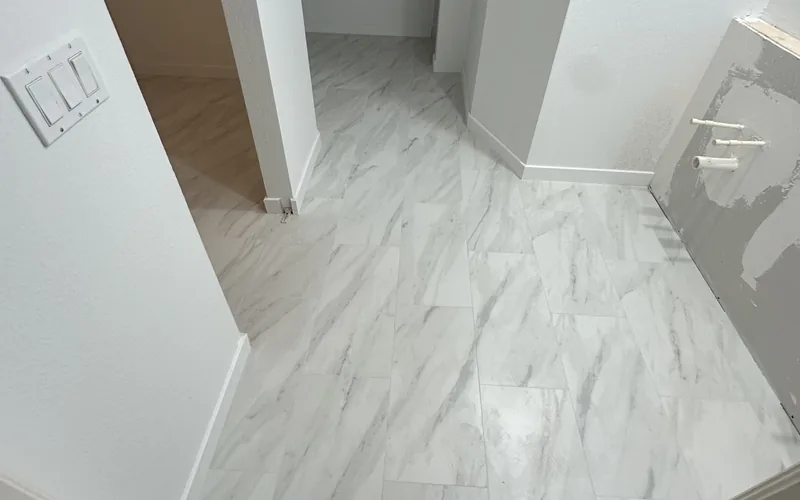
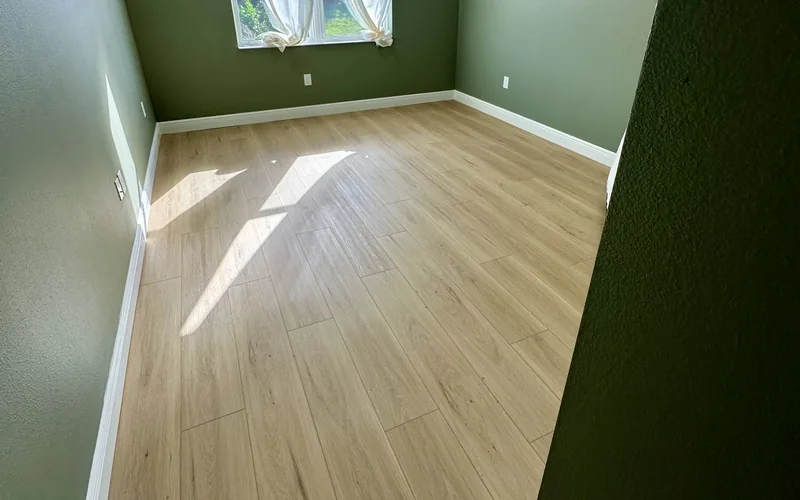
Porcelain tile holds up best in every Florida room type, from an air-conditioned sunroom to an open screened lanai. Vinyl plank works only in a room on your home's AC, and in a sun-filled room only if its installation guide approves sunrooms. Laminate needs full climate control. Screened lanais need exterior-rated, slip-resistant porcelain with closely spaced movement joints.
What is the best flooring for a Florida room, sunroom or lanai?
Start with two questions: does the room share your home's air conditioning all year, and does rain ever reach the floor? Porcelain tile works in every version of this room. Vinyl plank and laminate work only where the manufacturer's installation guide allows them, and most guides draw that line at climate control.
The name on the listing tells you little. A "Florida room" can be a conditioned addition or an old jalousie porch, and an "enclosed lanai" might have glass, vinyl panels or only screen. Sort the room by how it behaves.
| Room type | Porcelain tile | Vinyl plank (LVP/SPC) | Laminate |
|---|---|---|---|
| Florida room on the home's AC year-round, shaded or tinted glass | Yes | Yes, under the product's normal rules | Yes, if the room stays inside the maker's temperature and humidity limits |
| Sunroom on AC with lots of glass and direct sun on the floor | Yes, with movement joints spaced for sun | Only a product whose guide approves sunrooms, plus UV film or shades | We steer away |
| Enclosed porch with windows or vinyl panels and no AC | Yes | No, for the guides we've read | No |
| Screened lanai where rain blows in | Yes, porcelain rated for exterior wet use | No | No |
If the room is not on your home's air conditioning, plan on tile. For the rest of the house, our LVP vs porcelain tile room-by-room guide covers kitchens, bedrooms and baths.
Does it matter if my Florida room has air conditioning?
Yes, more than anything else. A room tied into the house system sees about the same temperature and humidity as your living room. A room without it sits at outdoor humidity all summer and heats up well past the rest of the house on a sunny afternoon. Floating floors move with those swings, and their warranties are written around climate control.
Before we recommend anything other than tile, we check:
- Is there a supply vent and return, or a mini-split, and does it run all year, including while you travel?
- Do the windows close tight with glass, or are they vinyl panels, jalousies or screen?
- Which way does the glass face? South and west exposures put the most sun on the floor.
A room that fails the first two checks is a screen room with walls as far as flooring goes. Seasonal homes where the AC is shut off for months land in the same group. If you plan to enclose or air-condition the space, finish that work before the floor goes in, and ask your county building department what permits the enclosure needs.
Can you put vinyl plank flooring in a sunroom?
Sometimes, if it is the right product and the room is on the AC. Rules differ by brand and even by product line, so read the exact guide before you buy.
The Lifeproof installation guide dated March 26, 2025 shows how specific this gets. It says not to install in outside areas, seasonal porches or lanais, and that SKUs with a wear layer of 22 mil or more can be installed in sunrooms and solariums. It also says the HVAC system must be on and functional before, during and after installation, and that after installation the room should stay between 40% and 60% relative humidity.
Sun is the other problem. The same guide warns that long-term direct sunlight can cause discoloration, fading and buckling, and asks for window treatments or UV-tinting. The limited warranty printed in it excludes changes in color or sheen from sunlight. In a glass room facing south or west, budget for shades or film as part of the floor.
A floating floor in a hot room needs space to move. We keep the expansion gap clear at every wall, column and door track, and we don't pin the floor under built-ins. Our luxury vinyl plank installation page lists the product grades we install.
Is laminate OK in a sunroom or enclosed porch?
Only in a sunroom that is air-conditioned like the rest of the house, and even then it is our last choice for that room. Laminate is built on a wood-fiber core, and its warranties are strict about climate.
One current example from Tampa-based Diamond Surfaces: the AquaShield water-resistant laminate warranty (October 2025) says the panels must be used indoors only and tells the owner to keep the home between 65°F and 85°F and 35% to 55% humidity. It says the warranty does not apply to damage from extreme heat, and that damage from fluctuation in temperature or humidity is not covered. Its fade coverage is written for fading from artificial light.
A Florida room that heats up every afternoon is the kind of swing that language excludes. Water resistance helps with spills; it does nothing for heat. If you love the look, use it in bedrooms and run tile or an approved vinyl in the sunroom.
What tile is safe on a screened lanai when it gets wet?
Porcelain that its manufacturer rates for exterior wet use. Rain blows through screens, and a lanai floor is often wet, sandy and sloped, so the tile has to shed water and still give bare feet some grip.
Two lines on the spec sheet matter most:
- Water absorption. Porcelain under ANSI A137.1 absorbs 0.50% or less of its weight in water, according to TileLetter's 2026 review of exterior tile standards. A tile that misses that mark may still suit exterior use, but only if its technical data sheet recommends it there.
- Slip category. The Tile Council of North America's ANSI A326.3 FAQ lists five use categories. Interior, Wet means a wet DCOF of 0.42 or higher (or manufacturer-declared). Exterior, Wet carries no set number and is declared by the manufacturer, so look for the EW category on any tile headed for a screened lanai.
That TCNA page is also clear about limits: DCOF helps compare surfaces, it does not predict whether a person will slip, and none of the categories address ramps or inclined surfaces. A lanai slab poured with drainage fall is a mild incline, so we lean toward matte or textured EW tile and skip polished finishes where wet feet land.
Setting matters outside too. Per the same TileLetter exterior standards article, ANSI A108.5 requires at least 95% mortar contact on the back of each tile in exterior installations, so we back-butter and pull tiles to check as we go. See our tile installation in Manatee, Sarasota and Tampa Bay page.
How far apart should tile movement joints be in a sunroom or lanai?
Closer together than in the rest of the house. Sun-heated tile expands, and a floor with no soft joints pushes against the walls and itself until it lifts. Movement joints give it room: gaps filled with flexible sealant in place of grout, at the edges and across the field.
The TCNA Handbook's EJ171 guideline, summarized in TileLetter's movement-joint article, sets how close those joints go. Outdoors the joints also get wider: at least 3/8 inch for joints 8 feet on center and 1/2 inch for joints 12 feet on center, plus 1/16 inch for each 15°F the tile surface temperature swings beyond 100°F between summer high and winter low.
| Where the tile is | Field joint spacing, each direction | Typical Florida room |
|---|---|---|
| Interior, out of direct sun | Maximum 25 ft | AC'd Florida room with shaded glass |
| Interior exposed to direct sunlight (heat) or moisture | Maximum 12 ft | Sunroom with big south or west glass |
| Exterior | 8 to 12 ft; more often may be required depending on materials and conditions | Screened lanai or open patio |
| Above-ground concrete slab | Maximum 12 ft | Upper-floor condo lanai |
| Perimeter and restraining surfaces | Required where tile meets walls, columns, curbs or other floor finishes | Walls, posts, thresholds, the step up to the house |
Where the slab already has saw-cut control joints, we carry them straight up through the tile with sealant instead of grouting over them.
Ask anyone bidding a sunroom or lanai where the movement joints will go. If the answer is that grout will do, expect trouble. Our guide to tiles popping up in Florida covers what happens when joints are left out.
What if my lanai slab is a step down or sloped?
Many Florida lanai slabs sit below the house floor and fall toward the yard so rain runs off. In an open or screened room that slope is doing its job, and tile should follow it. For exterior floors, TileLetter's summary of the TCNA Handbook says the Handbook calls for sloping the slab for complete drainage or, depending on the application, a deck slope of at least 1/4 inch per foot.
Enclose and air-condition the room and that slope becomes a problem for floating floors. The Lifeproof guide sets a subfloor flatness tolerance of 1/4 inch in 10 feet and a slope of no more than 1 inch per 6 feet. A slab draining 1/4 inch per foot drops 1-1/2 inches over 6 feet, so it would need leveling before that vinyl goes down.
Ways to handle the step and the slope:
- Keep the step, level the room with self-leveling underlayment, and finish the step edge with a matching nosing or bullnose tile.
- Raise the room to meet the house with a mortar bed or leveler, which removes the trip edge. Check door thresholds and slider tracks first, because the fill can bury them.
- Leave the fall in place and use tile, which follows a gentle slope that floating floors can't.
Ground-level Florida rooms are also where storm water gets in first; our waterproof flooring guide for Florida covers which floors survive that. On an upper-floor condo lanai, the association's rules come before product choice, and our Florida condo flooring rules guide explains what boards ask for.
What does sunroom or lanai flooring cost in 2026?
Our published ranges for the floors that fit each room are below. The final number depends on size, slab condition and how much leveling or demolition comes first, so we confirm it after measuring.
| Room type | Floor we'd usually install | Published 2026 range |
|---|---|---|
| AC'd Florida room, shaded | Mid-range LVP/SPC (6mm, 20-mil wear layer) | $2.50 - $5 / sq ft |
| AC'd sunroom, vinyl approved for sunrooms | Premium SPC (8mm, 22+ mil wear layer) | $4 - $7 / sq ft |
| Sunroom with direct sun, or screened lanai | Porcelain tile, 12x24 or 24x24 | $9 - $14 / sq ft |
| Any room, large-format look | Large-format porcelain (24x48 and up), needs a very flat substrate | $12 - $19 / sq ft |
| Stepped or uneven slab being leveled | Self-leveling underlayment under vinyl plank (tile leveling quoted after measuring) | $200 - $700 per room |
| Old tile coming out first | Tile removal, including thinset | $2.50 - $5 / sq ft |
New-floor measurements are free, with an itemized written quote within 24 hours; call (941) 402-6861. Every install carries our 1-year written labor warranty plus the manufacturer's product warranty.
This is general information about products and installation standards. Confirm the rules for your exact product with its current installation guide and warranty, and check enclosure or condo work with your county building department or association.
Last verified: October 20, 2026.
Frequently Asked Questions
Will vinyl plank fade next to my sliding glass doors?
It can. Vinyl manufacturers commonly warn that long-term direct sun can fade or discolor the floor, and the current warranty we reviewed excludes color or sheen changes from sunlight. UV-blocking window film, shades or blinds on south- and west-facing glass are the practical fix. For a wall of glass that gets afternoon sun, porcelain tile is our pick.
Is porcelain or ceramic better for an outdoor lanai?
Porcelain. It absorbs far less water than standard ceramic, which matters on a floor that gets rained on, and many porcelain lines carry an exterior wet slip classification. Use ceramic outside only if its technical data sheet says it is suitable for exterior use.
Can new tile go over a painted or sealed lanai slab?
Not directly. Paint, sealers and old coatings keep thinset from bonding, so we grind the slab back to clean concrete first. We also map cracks and existing control joints so the joints can be carried up through the new tile.
Should I put hardwood in my Florida room?
For most Florida rooms we advise against it. Wood moves with humidity and changes color in strong sun, so a room with lots of glass or any gaps in air conditioning is a poor fit. Porcelain tile or a vinyl plank approved for sunrooms is the lower-risk choice.
Are rubber-backed rugs okay on vinyl plank in a sunroom?
Check your product first. The vinyl warranty we reviewed excludes color or sheen changes caused by rubber-backed mats. Use rugs and pads with a backing your flooring manufacturer approves, and follow its care guide.
Does Triangle's warranty cover a sunroom or lanai floor?
Yes, our 1-year written labor warranty covers the installation in any room we install. The product side is the manufacturer's warranty, and that only holds if the product is approved for the room, which is why we check the installation guide before we quote.
Do you charge to measure a Florida room or lanai for new flooring?
No. Measurements for new floors are free, and you get an itemized written quote within 24 hours. Call (941) 402-6861 to set one up anywhere we work in Manatee, Sarasota, Hillsborough or Pinellas County.