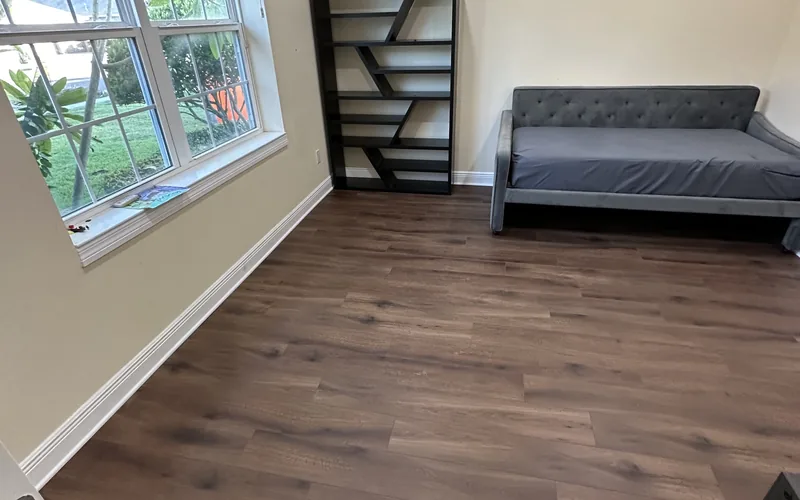
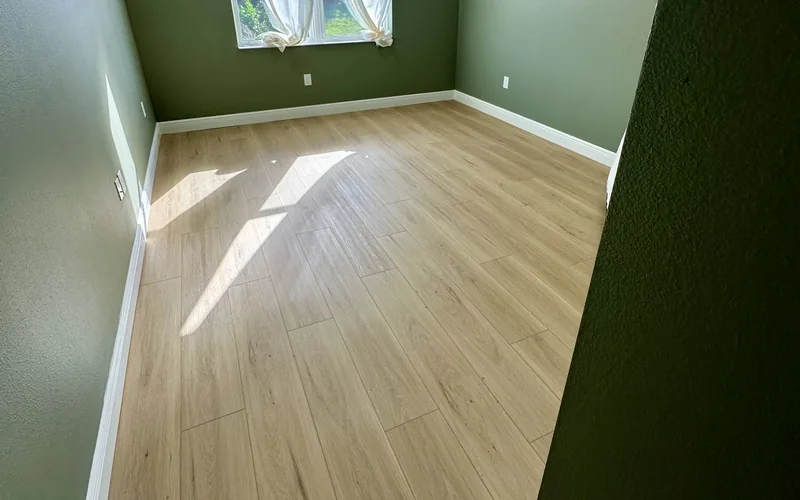
Vinyl plank separates, peaks or buckles when a floating floor cannot move freely or sits on a bad base. Usual causes are a missing expansion gap, cabinets or trim pinning the floor, long runs without transitions, sun heat, an uneven slab or water at the seams. Many are fixed by freeing the floor and relaying the same planks.
What do separating, peaking and buckling mean on a vinyl plank floor?
The three symptoms come from opposite problems. Gaps mean the floor shrank or the locks let go. Peaks and buckles mean the floor grew and had nowhere to go. Where and when the problem shows up tells you more than the symptom itself.
| What you see | Where it usually shows | Most likely cause | First check |
|---|---|---|---|
| Gaps at the short ends of planks | Sunny areas, after the weather cools | Floor shrinking after heat, or locks worn over a low spot | Do gaps come and go with the weather? Is there a dip under them? |
| Two plank edges lifted into a ridge (peaking) | Along a seam, often in a doorway or hallway | Floor pushing against itself because an edge or spot is pinned | Baseboards, door jambs, transitions, built-ins |
| A wide hump or wave (buckling) | Middle of a long room, in front of a slider | Expansion with no room to move, long runs, sun heat | Is it worse in the afternoon? How long is the run? |
| Planks that rock, click or flex, with gaps nearby | Anywhere, often in one patch | Uneven slab or old grout lines under the floor | Lay a long straightedge across the area |
| Dark seams, musty smell, swollen edges | Kitchens, baths, laundry, sliders | Water at the seams or under the floor | Lift a plank at the wall and look at the slab |
Many failing floors have a main cause and a helper, such as a tight perimeter plus a sunny slider, so we check every row before recommending a repair.
Why is my vinyl plank floor buckling along the walls or doorways?
A floating floor is clicked together and sits loose on the slab, so the whole floor grows and shrinks as it heats and cools. It needs open space at every wall and fixed edge. Shaw tells installers to always leave perimeter expansion space, and notes the amount varies by vinyl type. The Mannington ADURA Max installation guidelines (rev. May 2024) recommend a 1/4" expansion with no pinch points, and the NuCore plank instructions Floor & Decor publishes (the sheet is undated; most of its text was already published in early 2022) state that proper expansion space of 1/4" is required.
Gaps get lost in a few common ways:
- Baseboard or quarter round nailed through the planks instead of into the wall. Mannington warns against fastening moldings or transitions through the product.
- Door jambs that were not undercut, so the floor is jammed against the casing.
- Tile, a marble threshold or a tub edge butted tight, or the gap filled with grout or hard caulk.
- Transition strips screwed through the vinyl into the slab.
The fix is to pull the trim, cut the edge back to restore the gap and reset the trim so it holds only to the wall. Planks that lie flat once freed, with intact locks, go back down; cracked or bent ones get replaced.
Can a kitchen island or heavy furniture make a floating floor buckle?
Yes. Anything that locks the floor down turns that spot into an anchor, and the floor between it and the walls has to absorb all the movement. Mannington’s ADURA Max guide says not to install cabinets or kitchen islands on top of the floor, and NuCore’s instructions say not to install cabinets or fixed objects on top of it. When an island is set on a floating floor, peaked seams tend to show up in the open runs leading away from it.
Very heavy furniture does the same on a smaller scale. We treat a gun safe, a large aquarium, a piano or a loaded built-in bookcase as a pin point and plan the floor around it. NuCore also says floating floors are not recommended where there are heavy rolling loads.
To fix it, we cut the floor free around the island or cabinets, leave a gap and cover it with trim. If the island sits on the planks, it may have to be lifted, which adds a cabinet job and, if it has a sink or outlets, a licensed plumber or electrician to disconnect and reconnect them.
Does a long open floor plan need transition strips?
Often, and the limit depends on the product. Mannington says an ADURA Max open room area should not exceed 50 linear feet in either direction or 2,500 square feet in total, while NuCore calls for expansion moldings on floors over 6,400 square feet or longer than 80 feet in any direction. Two popular floors, two very different limits, so go by your exact product’s sheet.
Florida ranch plans often run one floor from the great room through the kitchen and down the hall into the bedrooms, and every doorway becomes a neck where two big rooms push against each other. Mannington also says transitions should be considered at room-to-room environment changes and complicated layouts, which fits many open plans with a sunny Florida room on one end.
The fix is a straight break at a doorway with a T-molding over it and the gap restored on both sides. The visible line is the trade-off for a floor that stays flat.
Why does my vinyl plank lift in front of the sliding glass door?
Sun through a slider can heat a strip of floor well above room temperature, and that strip grows while the shaded floor beside it stays put. Mannington says ADURA Max should not be exposed to temperatures greater than 140°F, warns that prolonged direct sunlight can cause discoloration and excessive temperatures may cause floor expansion that may cause buckling, and recommends blinds or drapes during peak sunlight hours.
The tell is timing: a sun buckle grows through the afternoon and eases after dark. West-facing sliders, Florida rooms full of glass and houses closed up for the summer with the AC set high are the usual settings. NuCore asks owners to keep the room between 60°F and 80°F after installation and warns that excessively high or low temperatures may cause visual defects it will not warrant.
Where flooring sits in direct sun for much of the day, NuCore recommends gluing the planks down in those areas with an approved premium cork flooring adhesive while keeping them clicked together. Check what your product allows. Our guide to flooring for a Florida room, sunroom or lanai covers rooms that are mostly glass.
Can an uneven slab make vinyl plank seams gap or peak?
Yes. A floating floor bridges low spots instead of following them, so every step over a dip flexes the locking joints. Over months the locks wear, ends open up and the floor clicks or sounds hollow. Over a hump, planks rock and the seam on top can lift into a peak.
Mannington asks for subfloors flat to within 3/16" in 10 feet and 1/32" in 12 inches and warns that unevenness may telegraph through the new floor. Florida slabs commonly have trowel ridges, cracks and low spots where a wall was removed. A floor laid over old tile can follow every grout joint; our page on putting LVP over existing tile covers that prep.
To check, lay a long straightedge or level across the problem area and look for daylight underneath. Repair means lifting the planks, grinding high spots, filling low ones with a cement-based patch or self-leveler, letting it cure and relaying the floor.
What happens when water gets into vinyl plank seams?
Rigid vinyl planks usually survive water, but water that runs through the seams sits on the slab under a floor that cannot dry out. Mannington notes that excessive subfloor moisture breeds mold, mildew and fungus, and its guidelines state the limited warranties “do not cover discoloration from mold or flooding, leaking plumbing or appliances, water entering through sliding glass doors or similar conditions.”
The water usually comes from a dishwasher or ice-maker line, a failed toilet wax ring, wind-driven rain past a slider during a storm, or a slab that wicks moisture. Look for dark lines along seams, a musty smell or loose planks. If the edges look swollen, check whether the floor is actually laminate: its wood-fiber core swells with water and the edges rarely flatten again.
The repair is to stop the source, lift the wet area back to the nearest wall, dry the slab and relay sound planks or replace damaged ones. For bigger leaks and storm water, start with our guide on what to do after floor water damage.
How is a separated or buckled vinyl floor repaired, and what does it cost?
Match the repair to the cause. New planks laid without fixing the gap, the pin point or the slab will fail the same way.
| Cause | Repair | Planks reused? | Triangle price (2026) |
|---|---|---|---|
| Missing gap or trim nailed through the floor | Pull trim, cut the edge back, reset trim to the wall | Usually | $250–$1,500+ per repair |
| Island, cabinets or heavy furniture pinning the floor | Cut the floor free, trim the cut edge | Usually | $250–$1,500+ per repair |
| Long run with no break | Add a T-molding at a doorway | Yes | $250–$1,500+ per repair |
| A few cracked or bent planks | Replace individual planks | Damaged ones replaced | $85–$150 per plank |
| Uneven slab | Lift, level, relay | Often | Self-leveling $200–$700 per room, plus lift and relay quoted after measuring |
| Water at the seams (10–50 sq ft) | Dry, prep, replace the section | Sometimes | $450–$1,500 |
| Whole floor failed | Remove and reinstall | No | Removal $1.50–$3/sq ft, new floor quoted after measuring |
A diagnosis visit is $95, waived if you book the repair, and includes a written quote. See our floor repair service for repairs across Manatee, Sarasota, Hillsborough and Pinellas counties.
Will the warranty cover a buckled floor, and how do I keep it from coming back?
Product warranties are written around manufacturing defects, and most causes above are installation or site conditions. NuCore’s instructions open with the line “Improper installation will void warranty.” Read your product’s warranty for its exact exclusions before filing a claim. Our installs carry a 1-year written labor warranty on top of the manufacturer’s product warranty.
To keep the problem from coming back:
- Keep the AC on when you travel, within your product’s stated range.
- Shade sliders and big west windows in the afternoon.
- Leave the perimeter gap open: no grout, hard caulk or tight trim.
- Ask before setting anything built in or very heavy on the floor.
- Fix leaks fast and dry the slab before relaying.
If the floor has to come up, the reinstall follows the same rules as a new vinyl plank flooring installation, including acclimation and jobsite conditions.
This is general information; for warranty coverage on your floor, confirm with the flooring manufacturer and your installer.
Last verified: October 27, 2026.
Frequently Asked Questions
Can I tap the gaps in my vinyl plank floor back together?
Sometimes. If a few end joints opened and the locks are not chipped, a tapping block and a scrap of flooring can close them. If the same gaps reopen within weeks, something is still pulling them apart, usually a dip in the slab or big temperature swings, and that has to be fixed first.
Will a buckled LVP floor go back down on its own?
A sun buckle can ease when the room cools, but it returns as long as the cause is there. A buckle from a tight edge or a pinned spot rarely settles by itself, and the longer the locks stay under pressure the more likely they are to crack. Freeing the floor early gives the best chance of reusing the planks.
Why do gaps open up in my vinyl floor when the weather cools off?
Vinyl shrinks as it cools, so a floor that spent the summer warm can open at the end joints once nights get cooler. Even gaps that come and go with the weather point to movement, while a gap that stays open in one spot points to worn locks or a low spot underneath. A steady indoor temperature year round keeps that movement small.
Can I caulk the gap between my vinyl floor and the baseboard?
Not with grout, wood filler or hard caulk. The gap at the wall has to stay open so the floor can move, and rigid fillers pin the edge in place. At tubs and toilet flanges, Mannington's instructions call for 100% silicone caulk, which stays flexible.
Is it normal for brand-new vinyl plank to have small gaps?
No. A click floor should be tight at every joint when the installer leaves. Gaps in the first few weeks usually mean locks that were never fully engaged, debris caught in a lock or a dip in the slab, so call the installer while the labor warranty is in effect.
Can one damaged plank be replaced without redoing the whole room?
Yes, when the cause is local and the rest of the floor is sound. Planks near a wall can be unclicked back to the damaged one, and planks in the middle can be cut out and a new piece set in. Matching is the hard part, so keep any leftover boxes.
How can I tell if my floor is vinyl plank or laminate?
Check a cut edge on a leftover plank, or the box label if you kept one. Laminate has a wood-fiber core that looks like dense brown cardboard, while vinyl plank has a plastic or stone-plastic core. It matters because water problems are repaired differently on each.