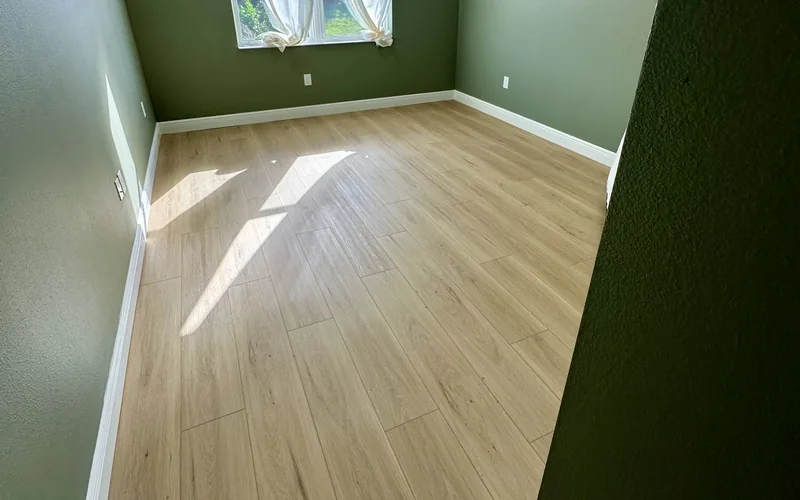
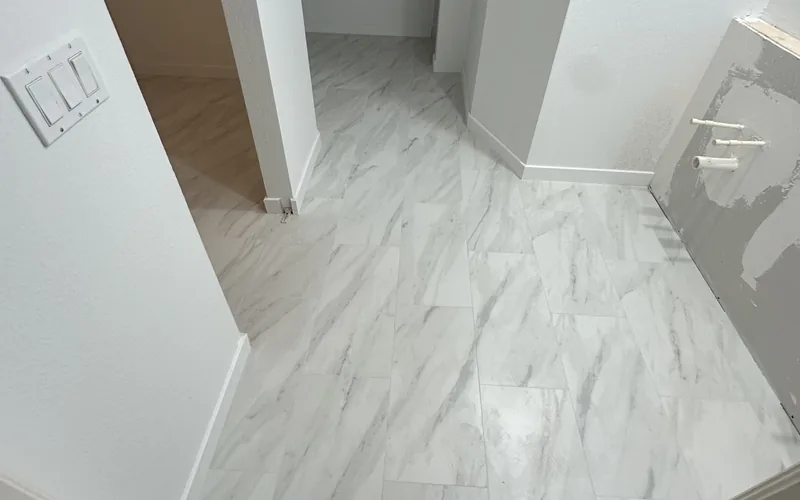
For most Florida homes, the safest floor for an older adult or walker user is firm, matte luxury vinyl plank in the dry rooms and porcelain tile rated for wet interior use in the bathrooms. Installation matters as much as material: flush or beveled transitions, no throw rugs, no thick cushion, and wet spots dried right away.
What is the safest flooring for seniors in a Florida home?
A safe floor for an older adult stays firm under a walker or wheelchair, grips when a wet foot comes in from the shower or pool, has no raised edges to catch a toe or wheel, and doesn't throw glare.
The CDC's older adult falls facts report that more than one out of four people 65 and older fall each year, that falling once doubles the chance of falling again, and that home hazards such as uneven steps and throw rugs are among the risks you can change.
| Floor type | Under a walker or wheelchair | When it gets wet | What to watch |
|---|---|---|---|
| Rigid-core vinyl plank (SPC), matte | Firm and smooth, rolls easily | Waterproof; slick under wet socks like any hard floor | Height jump at old tile |
| Porcelain tile, matte | Firm; wide grout joints can tick under walker glides | Depends on its slip classification (next section) | Hard landing on a concrete slab |
| Polished tile, marble or travertine | Firm | ANSI A326.3 limits low-traction surfaces, polished ones included, to areas kept dry unless the maker declares otherwise | Glare from sliders and windows |
| Laminate | Firm | Not for wet areas | Swelling if water sits at seams |
| Engineered hardwood | Firm | Keep it out of baths and wet entries | Florida humidity and slab moisture |
| Carpet or thick cushioned flooring | Drags; thick pads make wheels work harder | Carpet soaks up spills | Loose edges and thick pads |
Our default for an older adult's home is a matte, lightly textured rigid-core plank run continuously from room to room, with tile only where water is constant. See our luxury vinyl plank installation page for the product tiers we install.
How slippery is tile when wet, and what rating should I ask for?
Ask for the tile's product use classification under ANSI A326.3-2021, the national test method for the dynamic coefficient of friction (DCOF) of hard surface flooring. Each product is classified by where its maker expects it can be walked on.
| A326.3 classification | What the standard says | Where it fits in a Florida home |
|---|---|---|
| Interior, Dry (ID) | Kept dry, level and free of contaminants when in use | Bedrooms, living rooms and halls with no water source |
| Interior, Wet (IW) | Wet DCOF of 0.42 or higher, or manufacturer-declared (A326.3 Table 1) | Bathroom floors, kitchens, entries |
| Interior, Wet Plus (IW+) | Manufacturer-declared; an informative note says a wet DCOF of at least 0.50 is generally accepted (A326.3 section 4.1.3) | Covered lanai or porch under a roof |
| Exterior, Wet (EW) | Manufacturer-declared; an informative note says at least 0.55 is generally accepted (A326.3 section 4.1.4) | Open pool decks, patios and walkways |
Two more details matter at home. The standard sets no single number for shower floors, because size, drainage, the number of grout joints, texture and barefoot use all change the result; that is one reason we lean toward small mosaic tile on a shower floor. And a coating applied after installation, such as a topical gloss finish, puts the floor in the keep-it-dry group unless the coating's maker says otherwise.
The standard's introduction adds that a friction number does not predict whether a person will slip, and that a very grippy surface can make walking harder for older or disabled people who slide their feet. For someone who shuffles behind a walker, the most aggressive texture in the showroom can be the wrong pick for a dry room. On a bathroom tile installation, we check the classification on the spec sheet before tile is ordered.
How high can a threshold be for a walker or wheelchair?
The 2010 ADA Standards for Accessible Design are written for government buildings, public accommodations and commercial facilities. A private home isn't one of those, yet their change-in-level rules are the clearest design reference we have for a walker or wheelchair at home.
| Height difference | 2010 ADA Standards treatment | What we do in a home |
|---|---|---|
| Up to 1/4 inch | May be vertical (section 303.2) | Our target at every doorway |
| 1/4 to 1/2 inch | Beveled, no steeper than 1:2 (section 303.3) | Low-profile beveled reducer, fastened down |
| More than 1/2 inch | Must be ramped (section 303.4) | Remove the old floor or level the low side so the step disappears |
| Door thresholds | 1/2 inch maximum; existing or altered ones up to 3/4 inch if beveled on both sides no steeper than 1:2 (section 404.2.5) | Slider tracks stay as built; a small threshold ramp bridges them |
The usual trip edge comes from layering: new plank goes over old tile in the living area and stops at a bathroom that keeps its original tile, leaving a lip where someone turns a walker. Our guide to putting LVP or laminate over existing tile covers when layering works; in a walker household we usually take the old tile out so every room ends at the same height.
Plan the transitions before you choose the floor. A floating floor needs the expansion gaps and breaks its installation guide calls for, so we check the guide's maximum run before promising a doorway with no strip.
Is a softer, cushioned floor safer if someone falls?
Not on the evidence so far, and soft floors cost walker and wheelchair users effort every day. In the FLIP randomized trial published in PLOS Medicine in 2019, 150 resident rooms at a Canadian long-term care home got either a shock-absorbing layer or plywood under identical vinyl. Over four years, 12.5% of residents in the cushioned rooms and 13.3% in the rigid rooms had at least one serious fall injury, a difference the authors found was not significant. They note the result applies to that product in long-term care.
The ADA carpet rule shows the cost of softness. It calls for carpet that is securely attached, with a firm pad or none, pile no higher than 1/2 inch and fastened edges, and its advisory note says soft padding raises the force needed to push a wheelchair (2010 ADA Standards section 302.2).
Firm and level beats soft for anyone who walks with an aid. Under floating vinyl we use the underlayment the plank maker specifies and skip extra foam. If someone wants bedroom carpet, pick a tight, low loop and fasten every edge.
Should we keep area rugs, and does a shiny floor add risk?
Loose rugs should go. The National Institute on Aging's room-by-room fall prevention checklist says not to use throw rugs or small area rugs, to fix carpets firmly to the floor, to put no-slip strips on tile and wood floors, and to use nonskid mats or strips on bathroom surfaces that may get wet. It also recommends night lights near the bed and motion-activated lights along pathways.
A large rug under the sofa moves less than a runner, but its edge is still a lip, so keep it fastened and out of the path to the bath.
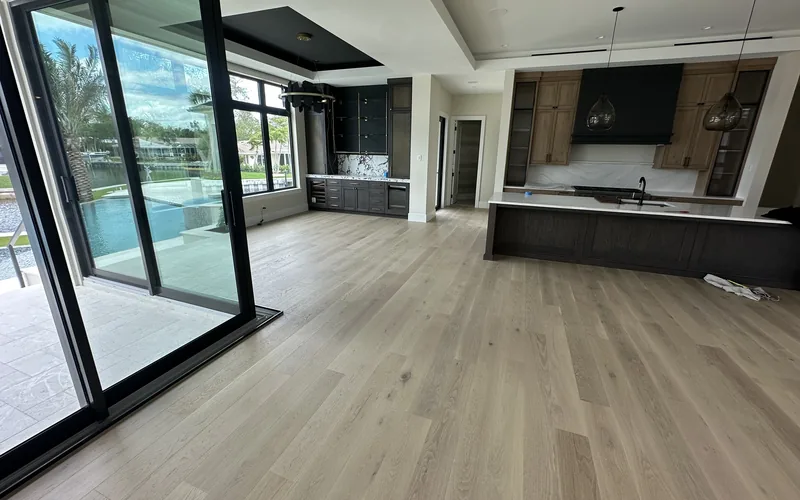
Glare is the Florida-specific problem. Afternoon sun through a slider hits glossy tile or high-sheen plank and turns part of the room into a bright patch that hides a spill, a dropped pill or the edge of a step. Pick a matte or low-sheen finish in a color that contrasts with the walls, the furniture and any step or shower curb. A floor that matches the step color makes the edge hard to read.
What flooring is safest in each room for a senior?
Room by room, the choice turns on how much water reaches the floor and how the person moves. Our LVP vs porcelain tile comparison covers durability and price by room; this table adds the safety details for an older adult's home.
| Room | Main fall risk | What we install | Detail that matters |
|---|---|---|---|
| Entry and garage door | Wet shoes after rain | Matte vinyl plank or Interior, Wet tile | Flush transition at the door; no loose mat |
| Living and great room | Glare from sliders, long walking paths | Matte rigid-core vinyl plank | One continuous floor into the halls |
| Kitchen | Spills while standing at counters | Vinyl plank or Interior, Wet tile | Wipe spills at once |
| Bathroom floor | Wet bare feet | Matte porcelain classified Interior, Wet | Level with the hall floor; no thick bath rug |
| Shower | Soap, standing water, stepping over a curb | Small mosaic porcelain on a sloped, waterproofed floor, curbless where possible | Pair it with grab bars |
| Bedroom | Night trips to the bathroom in socks | Vinyl plank, or low-loop carpet with a firm pad | A clear, lit path to the bath |
| Covered lanai | Wet feet from the pool or rain | Tile its maker classifies for wet or covered exterior use | Slope so water drains away |
| Stairs, if any | Step edges that are hard to see | Treads with a contrasting non-slip nosing | Handrails on both sides |
What should retirees in Sun City Center, Venice or Lakewood Ranch check first?
If your home in Sun City Center, Venice or a Lakewood Ranch village is part of a condo association or HOA, flooring changes may need approval, and some condo boards set sound ratings for hard floors. Our Florida condo flooring rules guide explains what boards ask for, so get that answer before you pick a product.
- Bring any therapist notes. If a doctor or occupational therapist has done a home safety visit, their notes on walker width, grab bar spots and problem doorways shape where transitions go.
- Show us the walker or wheelchair path, including the turn into the bathroom.
- On a slab we test moisture before vinyl goes down and check flatness, because dips and humps under a plank become edges over time.
If you live in the area, our page on flooring in Sun City Center covers the services we offer there.
What does a fall-safer floor cost in 2026?
These are Triangle's published 2026 ranges. On a safety job, prep often decides the price, because removing old tile and leveling the low side is what gets rid of a raised edge.
| Work | Published range | Typical 200 sq ft area |
|---|---|---|
| Luxury vinyl plank (LVP/SPC) | $3.91–$11.11 / sq ft | $782–$2,222 |
| Porcelain or ceramic tile | $7.50–$22.00 / sq ft | $1,500–$4,400 |
| Tile removal, thinset included | $2.50–$5 / sq ft | Quoted after measuring |
| Subfloor self-leveling | $200–$700 per room | Only if needed |
| Curbless shower, waterproofing only | $1,800–$3,200 | Tile priced separately |
| Porcelain tile stair tread with non-slip nosing | $80–$150 / tread | Per step |
Your final number comes in a written quote after we measure. Every install carries our 1-year written labor warranty plus the manufacturer's product warranty.
This guide is general information about flooring. For a personal fall-risk assessment, talk with your doctor or an occupational therapist, and confirm flooring rules with your condo association or HOA before work starts.
Last verified: November 3, 2026.
Frequently Asked Questions
Is vinyl plank flooring slippery for elderly people?
Dry, a matte rigid-core vinyl plank gives steady footing for shoes, bare feet and walker glides. Like any hard floor, it turns slick with water or lotion on it, so wipe up shower drips and spills right away. Choose a low-sheen, lightly textured surface and ask to see the slip-resistance data on the product's spec sheet.
Will a walker scratch vinyl plank flooring?
A walker with worn glides or bare metal tips can scuff any floor, so replace the glides when they wear through. A thicker wear layer resists scuffs better; our mid-range and premium tiers carry 20-mil and 22-mil-plus wear layers. For a heavy power wheelchair, ask whether the plank maker's warranty covers rolling loads.
Is laminate a safe choice for an older homeowner in Florida?
In dry bedrooms, laminate can be as firm and level as vinyl plank. It is not meant for wet areas, so it doesn't belong in baths, kitchens or entries, and switching materials at those doorways adds transitions. If you want one continuous floor through the house, waterproof vinyl plank is usually the simpler fit.
Should the whole house have the same floor?
Where you can, yes, because every material change at a doorway is a possible edge. We usually run one vinyl plank through the living areas, halls and bedrooms and switch to tile only in the bathrooms and shower, with each change set flush or beveled. Fewer transitions also means fewer places for a walker to catch.
Is a curbless shower worth it for aging in place?
For a walker or wheelchair user, usually yes, because it removes the curb you would otherwise step over with wet feet. On a slab, the floor has to be recessed or built up so water still runs to the drain, and the waterproofing has to be done right. We check which approach your bathroom allows when we measure, and grab bars should go in at the same time.
Can we stay in the house while the floors are replaced?
Usually yes, if the work is phased. We plan the order so a bed, a bathroom and the path between them stay usable each night, and any open edge between old and new floor gets a temporary transition. Ask for the room-by-room sequence when you get your quote.
Does it cost anything to have someone look at our floors?
Measuring for a new floor is free, and you get an itemized written quote within 24 hours. If the issue is a repair, such as a lifted plank or cracked tile that has become a trip edge, the diagnosis visit is $95 and is waived if you book the repair.