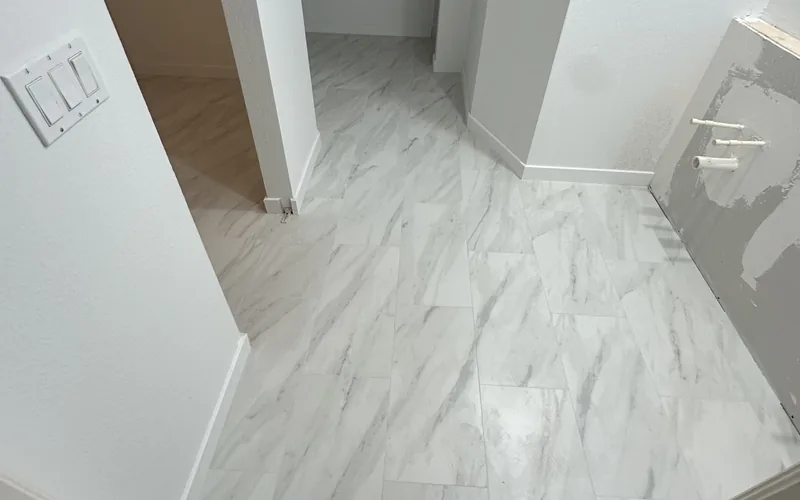
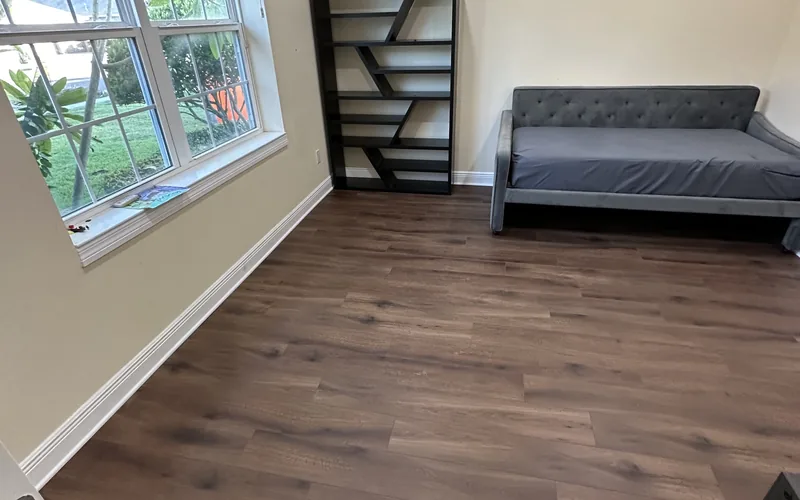
Porcelain is ceramic tile that absorbs 0.5% water or less under ANSI A137.1, making it the usual pick for busy floors, shower floors and lanais when its slip rating fits. Standard ceramic is the better buy for walls and backsplashes. On floors, check the data sheet for abrasion class, wet slip rating and through-body color.
What is the difference between porcelain and ceramic tile?
Porcelain is a type of ceramic tile. The dividing line comes from ANSI A137.1, the American National Standard for ceramic tile. It separates porcelain from all other ceramic tile by how much water the fired tile absorbs in the ASTM C373 lab test. Tile that falls short of that line is non-porcelain ceramic, even when it is sold for floors.
Manufacturers get there with a finer clay mix fired at higher temperatures. Daltile's comparison describes the result: porcelain comes out denser and harder, while ceramic stays slightly more porous, softer and easier to cut.
In a Florida house the difference shows up in two places: outdoor and wet areas, and how hard the tile is to cut and set. Indoors on a dry, level floor, a glazed ceramic tile rated for floors holds up well, and household humidity does not hurt either one.
How do you know a tile is really porcelain?
Check the paperwork. The Tile Council of North America says some sellers market tile as porcelain when it does not meet the porcelain standard. That is why the Tile Council and the Ceramic Tile Distributors Association launched the Porcelain Tile Certification Agency (PTCA). Manufacturers whose tile passes independent testing can print the PTCA mark on boxes and marketing.
The program is voluntary, so a box without the mark is not automatically a fake. It means you need the technical data sheet. Find the water absorption line and the test method beside it. If the result is above the porcelain limit, or the sheet does not list one, plan the job as if the tile is ceramic.
Weight, the color of the back and the sound a tile makes when tapped are not reliable tests. We read the data sheet before a tile goes on a lanai, a shower floor or a sandy entry where it has to perform.
Which numbers on a tile spec sheet actually matter?
Porcelain or ceramic is only the first line. Four other entries decide where a tile can go, and a porcelain tile can still be wrong for a spot if one of them is off.
| Spec sheet line | What it tells you | What to look for in a Florida home |
|---|---|---|
| Water absorption | Porcelain or not. Porcelain is 0.5% or less by ASTM C373 under ANSI A137.1. | Matters most outdoors, on shower floors and anywhere water sits. |
| Abrasion class (PEI) | How a glazed surface resists visible wear in the ASTM C1027 test. In Marazzi's floor recommendations by class, Class 0 is not recommended for floors, Class 3 suits residential kitchens and hallways, and Class 4 covers floors with considerable traffic and scratching dirt, such as entrances. Unglazed tile has its own deep abrasion test, ASTM C1243. | Sand tracked in from the beach or pool deck is scratching dirt, so an entry needs a higher class than a guest bath, plus a mat at the door. |
| Wet DCOF and product use class | Slip classification under ANSI A326.3: Interior, Wet (IW) means a wet DCOF of 0.42 or higher, or manufacturer-declared; Interior, Wet Plus and Exterior, Wet are manufacturer-declared. | We look for IW or better in kitchens, baths and the path in from the pool slider, and an Exterior, Wet listing for lanais. |
| Glazed or through-body | Whether a chip shows a different color. Through-body tile is the same color throughout. | Worth it on busy floors; irrelevant on walls. |
| Approved uses | The maker's list of floors, walls, wet areas and exterior. | Wall-only tile stays on walls, no matter how good it looks. |
Is porcelain tile less slippery than ceramic when wet?
Not by default. Grip comes from the surface: texture, finish and any coating. A polished porcelain can be slicker underfoot than a matte glazed ceramic. To judge grip, compare the wet classification in the table above and ignore the porcelain label.
The Tile Council's FAQ on the ANSI A326.3 slip standard adds two cautions. A DCOF number helps compare surfaces but does not predict whether a person will slip, and it should not be the only factor in choosing a floor. Coatings added after firing or after installation belong only where the floor can be kept dry, unless the coating maker declares otherwise.
In Florida, the wet zones are the shower floor, the kitchen sink and the path in from the pool or beach. On shower floors we use small porcelain tiles or mosaics, because the extra grout lines add grip and let the floor follow the slope to the drain. Polished and high-gloss finishes go in rooms that stay dry. Walls never have a slip problem, which is one reason ceramic does so well there.
Does glazed or through-body porcelain matter on a floor?
It matters on floors that take abuse. Glazed porcelain carries its color and pattern in a glaze on top of the body, so a dropped cast iron pan can leave a chip that shows the body underneath. Crossville's explainer sorts porcelain into three builds: through-body is unglazed with color through the whole tile, color-body is glazed over a body tinted to coordinate with the surface, and plain glazed may or may not match underneath. The same piece notes that through-body tile is not stronger just because the color runs through.
A chip in through-body tile exposes more of the same color, which is why it hides damage so well. Color-body softens the contrast at a chip or a cut edge. If the look you want only comes glazed, a lighter, mottled pattern hides a chip better than a dark solid color, and felt pads under chairs and bar stools help.
Keep a box of spare tiles from the same lot. Tile boxes carry shade and size codes, and a later production run can come out a different shade. With a matching spare, a cracked or chipped tile can be cut out and replaced so it blends in. Our floor repair service replaces single cracked tiles for $95–$175 per tile, grout matching included. If you are not sure what caused the crack, the diagnosis visit is $95 and waived if you book the repair.
When is ceramic tile the better choice?
On walls and backsplashes. Ceramic is softer and cuts cleanly, which helps with outlet cutouts, niches and the rows of small cuts a backsplash needs. It also costs less per square foot to buy and install, and it comes in a wide range of colors, shapes and handmade looks.
Shower and tub walls are a good ceramic job too, as long as the tile maker approves it for wet walls and the wall behind it is waterproofed. The Tile Council's installation FAQ reminds homeowners that grout joints are not waterproof, so in a shower the method and substrate have to protect the wall. We compare the two membranes we use in RedGard vs Kerdi shower waterproofing.
Ceramic floor tile still works on low-traffic indoor floors like a guest bath, closet or laundry room, if its abrasion class and wet rating fit the room. It is rarely the right pick for lanais, pool decks, shower floors and sandy entries. Use it there only if the maker rates it for that use. Those are the spots where porcelain's low absorption and wear resistance are worth the extra cost.
Which tile goes where in a Florida home?
What decides it is where the tile goes, more than the room name. Here is how we match tile to each spot in a typical Tampa Bay slab home.
| Location | Ceramic | Porcelain | What decides it |
|---|---|---|---|
| Kitchen backsplash | Good fit | Works, slower to cut | Look and budget; no foot traffic |
| Shower and tub walls | Good fit if approved for wet walls | Good fit | Waterproofing behind the tile |
| Shower floor | Only if rated for it | Our default | Wet slip class and small format for the slope |
| Guest bath, laundry, closet floors | Fine with a floor-rated abrasion class | Fine | Abrasion class and wet rating |
| Kitchen and living areas | Possible with a higher abrasion class | Usual pick | Traffic, chip visibility, tile size and slab flatness |
| Entry from pool, garage or beach | Only if rated for heavy traffic | Usual pick | Abrasive sand and wet feet |
| Covered lanai or pool deck | Only if rated for exterior | Exterior-rated only | Exterior, Wet classification |
A lanai has more options than tile, and we compare them in our Florida room, sunroom and lanai flooring guide. If you are deciding between tile and vinyl plank for the main living areas, that comparison has its own page: LVP vs porcelain tile in Florida.
Does porcelain tile install differently than ceramic?
Yes, and the differences show up in labor time and on the quote.
- Mortar. The Tile Council's FAQ says to use the setting materials recommended for the tile, the substrate and the location, and not to save money on them. Because porcelain absorbs so little, we use a mortar whose bag lists porcelain as an approved tile, with the trowel size printed on it.
- Cutting. Porcelain is harder to score and snap, and notches at outlets, vents and door jambs usually need a wet saw or grinder with a porcelain blade, so cuts take longer. Ceramic scores and snaps more easily.
- Flatness. Porcelain often comes in large formats and long planks, which show every high and low spot in a slab. Our large-format tile guide covers flattening the slab and controlling lippage.
- Slab cracks. Either tile will crack over a slab that moves. The same FAQ notes the TCNA Handbook recommends carrying concrete control joints up through the tile, so on slab homes we map cracks and joints before we lay anything out.
Both tiles need full mortar contact, because hollow spots under a tile are where cracks and loose tiles start. Our tile installation quotes spell out the mortar, membrane and prep for the exact tile you pick.
How much more does porcelain cost to install?
Porcelain costs more per square foot to install than standard ceramic, and the gap grows with tile size because large formats need a flatter floor and more handling. These are the ranges published on our tile page.
| Tile type and size | Notes | Published range |
|---|---|---|
| Standard ceramic (12×12, 12×24) | Basic install | $7–$11/sq ft |
| Porcelain (12×24, 24×24) | Most common residential size | $9–$14/sq ft |
| Large-format porcelain (24×48 and up) | Requires a perfectly flat substrate | $12–$19/sq ft |
| Tile backsplash | Kitchen or bathroom | $14–$27/sq ft |
| Tile removal | Includes thinset removal | $2.50–$5/sq ft |
Your exact number depends on the tile, the slab and the layout. Measurement for a new floor is free, and you get an itemized written quote within 24 hours. Call (941) 402-6861.
Tile ratings and approved uses here are general information. Confirm them for your exact tile on the manufacturer's current technical data sheet before you buy.
Last verified: November 17, 2026.
Frequently Asked Questions
Can ceramic wall tile go on a floor?
No, not if the manufacturer lists it as wall-only. Wall tile is made for surfaces that never carry foot traffic, and its glaze can wear through or crack under feet and furniture. Floor-rated tile can go on walls, though, and that is a common way to carry the bathroom floor tile up the tub or shower walls.
Does porcelain tile crack less than ceramic?
Porcelain is harder and denser, but either one will crack if the floor under it moves or the tile was set over hollow spots. On Florida slabs, a cracked tile usually traces back to a crack in the concrete or a void in the mortar. Good slab prep and full mortar contact matter more than which tile you choose.
Can I mix porcelain on the floor and ceramic on the walls in one bathroom?
Yes, and it is one of the most practical combinations. Porcelain goes on the floor where wear and wet slip matter, and ceramic goes on the walls where it cuts easily and costs less. Plan the tile thicknesses at the tub and shower curb and pick grout colors for both at the same time.
Will tile fade in front of a sunny slider?
No. The color in ceramic and porcelain tile is fired into the glaze or body, so Florida sun through a slider does not bleach it the way it can fade some wood and vinyl floors. Rugs and furniture next to the tile will still fade, and a sun-heated floor can feel warm underfoot.
What does rectified mean on a tile box?
Rectified tile is precision-sized, so it can be set with closer grout joints than rustic or cushion-edge tile. Both porcelain and ceramic can be rectified. Tighter joints leave less room to hide size variation and uneven edges, so the floor under them has to be flatter.
Can new porcelain go over my old ceramic tile?
Sometimes. The old tile has to be solidly bonded, flat and free of cracks, and the added height has to work at doors, transitions and appliances. We sound the floor for hollow tiles first, and if many are loose, tearing out the old tile is the better path.
Is wood-look tile porcelain or ceramic?
It can be either, so check the water absorption line and approved uses the same way you would for any tile. Plank shapes add layout work, because the stagger between rows and the plank length both affect how flat the finished floor looks. Ask your installer how they plan the stagger before the job starts.